Connect with us

Education

How to Use ChatGPT for School Assignments: A Comprehensive Guide

Published

on

How to Use ChatGPT for School Assignments Easily

In today’s digital age, students are increasingly turning to artificial intelligence (AI) tools to enhance their academic performance. Among these tools, ChatGPT, developed by OpenAI, stands out as a powerful resource for assisting with school assignments. From brainstorming ideas to refining essays, ChatGPT can streamline the learning process when used responsibly. This guide explores how to use ChatGPT for school assignments, offering practical tips, ethical considerations, and strategies to maximize its benefits while maintaining academic integrity.

What is ChatGPT?

ChatGPT is a conversational AI model that uses advanced natural language processing to generate human-like text. It can answer questions, provide explanations, generate ideas, and even assist with writing tasks. For students, it serves as a versatile tool to support various aspects of schoolwork, including research, essay writing, problem-solving, and exam preparation. However, to make the most of ChatGPT for school assignments, students must understand how to use it effectively and ethically.

Why Use ChatGPT for School Assignments?

Using AI tools like ChatGPT offers several advantages:

  • Time Efficiency: Quickly generates ideas, outlines, or explanations, saving time on repetitive tasks.
  • Improved Understanding: Breaks down complex topics into simple, digestible explanations.
  • Enhanced Creativity: Sparks inspiration for essays, projects, or presentations.
  • Accessibility: Available 24/7, providing instant support for students working on tight deadlines.

However, it’s critical to use ChatGPT as a supplement to your learning, not a replacement for critical thinking or original work.

Step-by-Step Guide to Using ChatGPT for School Assignments

1. Brainstorming Ideas

One of the most effective ways to use ChatGPT for school assignments is for brainstorming. Whether you are stuck on a topic for an essay or need creative ideas for a project, ChatGPT can generate a variety of suggestions.

How to Do It:

  • Input a prompt like, “Suggest 10 unique essay topics on climate change for a high school assignment.”
  • ChatGPT will provide a list of ideas, such as “The impact of deforestation on global warming” or “Innovative solutions to reduce carbon footprints in urban areas.”
  • Use these suggestions as a starting point and refine them based on your assignment requirements.

Tip: Be specific with your prompts. For example, instead of asking, “Give me essay ideas,” specify the subject, word count, or academic level to get tailored responses.

2. Creating Outlines

A well-structured outline is the backbone of any successful assignment. ChatGPT can help you create a detailed outline to organize your thoughts.

How to Do It:

  • Ask ChatGPT, “Create a detailed outline for a 1000-word essay on the causes of the American Revolution.”
  • The tool will provide a structured outline with an introduction, body paragraphs (e.g., political causes, economic factors, social tensions), and a conclusion.
  • Customize the outline to align with your teacher’s guidelines or your personal writing style.

Benefit: This approach helps you save time and ensures your assignment is logically organized, which is key to academic writing with ChatGPT.

3. Research Assistance

ChatGPT can assist with preliminary research by summarizing topics, explaining concepts, or identifying key points to explore further.

How to Do It:

  • Ask, “Summarize the key causes of World War I in 200 words.”
  • ChatGPT will provide a concise overview, which you can use as a foundation for deeper research.
  • Follow up by asking for specific details, such as, “Explain the role of alliances in World War I.”

Caution: Always verify ChatGPT’s responses with credible sources, as AI may occasionally provide inaccurate or outdated information. Cross-check facts using academic databases, textbooks, or reputable websites.

4. Drafting and Writing Support

ChatGPT excels at generating drafts or providing sentence-level suggestions to enhance your writing. This is particularly useful for academic writing, where clarity and structure are essential.

How to Do It:

  • Request a draft by saying, “Write a 300-word introduction for an essay on renewable energy sources.”
  • Alternatively, ask for help with specific sections, like, “Write a thesis statement for an essay on the benefits of recycling.”
  • Use the generated text as inspiration or a rough draft, then revise it to reflect your voice and meet assignment requirements.

Tip: Avoid submitting ChatGPT-generated text directly, as this may violate academic integrity policies. Instead, use it as a guide to craft your own work.

5. Editing and Proofreading

Polishing your assignments is crucial for earning high grades. ChatGPT can help you refine your writing by suggesting improvements in grammar, style, and clarity.

How to Do It:

  • Paste your draft into ChatGPT and ask, “Can you proofread this essay and suggest improvements for clarity and flow?”
  • The tool will highlight grammatical errors, awkward phrasing, or weak arguments and provide suggestions to enhance readability.
  • You can also ask for specific feedback, such as, “How can I make this paragraph more concise?”

Benefit: This feature helps you improve study efficiency by streamlining the editing process, allowing you to focus on content quality.

6. Problem-Solving for Math and Science

ChatGPT isn’t limited to writing assignments—it can also assist with subjects like math, physics, or chemistry by explaining concepts or solving problems step-by-step.

How to Do It:

  • For math, ask, “Solve this equation step-by-step: 2x + 5 = 15.”
  • For science, try, “Explain the process of photosynthesis in simple terms.”
  • ChatGPT will provide clear explanations or calculations, making it easier to grasp complex topics.

Note: Double-check calculations or scientific explanations, as AI may occasionally make errors in technical subjects.

7. Exam Preparation

ChatGPT can help you prepare for exams by generating practice questions, summarizing key topics, or creating study guides.

How to Do It:

  • Ask, “Create 10 practice questions for a biology exam on cell division.”
  • Request summaries, like, “Summarize the key themes in ‘To Kill a Mockingbird’ for a literature exam.”
  • Use these resources to test your knowledge and focus your study sessions.

Benefit: This approach enhances your ability to improve study efficiency by targeting weak areas and reinforcing key concepts.

Ethical Use of AI in Education

While ChatGPT is a powerful tool, the ethical use of AI in education is paramount. Misusing AI can lead to plagiarism or academic dishonesty, which can have serious consequences. Here are some guidelines to ensure responsible use:

  • Use ChatGPT as a Learning Aid: Treat ChatGPT as a tutor, not a shortcut. Use it to understand concepts, generate ideas, or refine your work, but always produce your own final product.
  • Cite AI Assistance if Required: Some schools require students to disclose the use of AI tools. Check your institution’s policies to avoid violations.
  • Avoid Over-Reliance: Relying too heavily on ChatGPT can hinder your critical thinking and writing skills. Use it to supplement, not replace, your efforts.
  • Verify Information: Cross-check ChatGPT’s responses with reliable sources to ensure accuracy, especially for research-based assignments.

By adhering to these principles, you can leverage ChatGPT for school assignments while maintaining academic integrity.

Best Practices for Using ChatGPT Effectively

To maximize the benefits of AI tools for students, follow these best practices:

  1. Craft Clear Prompts: The quality of ChatGPT’s output depends on the specificity of your input. For example, instead of asking, “Help me with history,” try, “Explain the significance of the Magna Carta in 150 words.”
  2. Iterate and Refine: If ChatGPT’s response isn’t quite right, rephrase your prompt or ask follow-up questions to get more relevant results.
  3. Combine with Other Resources: Use ChatGPT alongside textbooks, academic journals, or teacher feedback to create well-rounded assignments.
  4. Set Time Limits: While ChatGPT can save time, it’s easy to get lost in endless prompt tweaking. Allocate specific times for using the tool to stay productive.
  5. Stay Updated on School Policies: Some schools have strict guidelines on AI use. Familiarize yourself with these rules to avoid penalties.

Limitations of ChatGPT for School Assignments

While ChatGPT is a valuable tool, it has limitations:

  • Potential for Errors: ChatGPT may provide inaccurate or incomplete information, especially for niche or highly technical topics.
  • Lack of Personal Voice: AI-generated text may lack the unique tone or perspective required for creative assignments.
  • Plagiarism Risks: Submitting ChatGPT’s output as your own work can lead to plagiarism violations, as some institutions use AI-detection software.
  • Limited Contextual Understanding: ChatGPT may not fully grasp the specific requirements of your assignment or your teacher’s expectations.

To overcome these limitations, always review and personalize ChatGPT’s output to align with your academic goals.

Conclusion

Using ChatGPT for school assignments can transform the way you approach studying, writing, and problem-solving. By leveraging its capabilities for brainstorming, outlining, researching, drafting, editing, and exam preparation, you can improve study efficiency and produce high-quality work. However, the ethical use of AI in education is critical to maintaining academic integrity and fostering genuine learning. By combining ChatGPT with your own efforts and credible resources, you can harness the power of AI tools to excel in your academic journey.

Whether you are crafting an essay, solving math problems, or preparing for exams, ChatGPT can be a valuable ally when used responsibly. Start experimenting with the tool today, and discover how it can enhance your academic writing while helping you achieve your educational goals.


Discover more from Daily Media NG

Subscribe to get the latest posts sent to your email.

Click to comment

Leave a Reply

Your email address will not be published. Required fields are marked *

Career

From Oil Fields to Mind Fields: How Digital Skills Initiatives Can Power Nigeria’s Next Economy

Published

on

From Oil Fields to Mind Fields: How Digital Skills Initiatives Can Power Nigeria's Next Economy

From Oil Fields to Mind Fields: How Digital Skills Initiatives Can Power Nigeria’s Next Economy

For over six decades, Nigeria’s economic story has been written in crude oil. The Niger Delta’s wells filled national coffers, funded budgets, and shaped foreign policy. But oil was always a finite bet — vulnerable to price shocks, environmental fallout, and a global market slowly turning away from fossil fuels. Today, a quieter but far more durable resource is emerging as the country’s real growth engine: the Nigerian mind.

The shift from oil fields to “mind fields” isn’t just a clever phrase. It’s a structural transformation already visible in the numbers, and it’s being accelerated by a wave of digital skills initiatives — programs like MODE Digital Creations’ Digital Skills Initiative — that are quietly building the workforce Nigeria needs for its next chapter.

The Numbers Tell the Story

Nigeria’s Information and Communication sector grew 9.62% year-on-year in Q2 2026 — more than twice the pace of the overall economy — and now contributes 11.74% of the country’s real GDP, up from 11.18% a year earlier. That is not a rounding error; it’s one of the fastest-growing components of the entire economy, and it’s growing precisely as oil’s dominance becomes harder to sustain.

Nigeria’s digital economy revenue is projected to reach $18.3 billion by end of 2026, up from $9.97 billion in 2021 nearly doubling in five years. Nigeria already leads Africa in start-up investment and is home to five tech unicorns: Interswitch, Flutterwave, OPay, Andela, and Moniepoint. Meanwhile, internet penetration reached roughly 107 million users in early 2025, with mobile-first access accounting for over 90% of national connectivity.

This is a country whose economic center of gravity is visibly shifting — from what is under the ground to what is between people’s ears.

Why Skills, Not Just Infrastructure, Is the Real Bottleneck

It’s tempting to think Nigeria’s digital transformation is mainly about fiber cables, data centers, and 5G towers. Infrastructure matters — and it’s expanding — but infrastructure without a skilled workforce is just plumbing with no water running through it.

This is where the gap actually bites. Nigeria has one of the youngest populations on earth, with tens of millions of young people entering the labor market each year, many with degrees but without the practical, market-ready digital competencies that employers — local and global — are hiring for right now: UI/UX design, front-end and back-end development, data analysis, digital marketing, product management, graphic design, video editing, and increasingly, applied AI tools.

Formal education systems, however well-intentioned, have struggled to keep pace with how fast these skill requirements evolve. That is the vacuum that grassroots and private-sector digital skills initiatives have moved to fill.

The Role of Programs Like MODE Digital Creations’ Digital Skills Initiative

This is precisely the gap that initiatives such as MODE Digital Creations’ Digital Skills Initiative Project are built to close. Programs of this kind matter economically for a few concrete reasons:

1. They shorten the distance between training and income. Unlike multi-year academic degrees, focused digital skills bootcamps and initiatives are designed to get participants job-ready or freelance-ready in months, not years. For a young Nigerian facing underemployment, that speed is the difference between years of waiting and immediate economic participation.

2. They plug directly into a borderless labor market. A Nigerian trained in software development, digital design, or content creation isn’t limited to hiring managers in Lagos or Abuja. They can serve clients in London, Toronto, or Dubai from a laptop. This means digital skills initiatives don’t just create local jobs — they create export earners, pulling foreign currency into the Nigerian economy the same way oil once did, but distributed across thousands of individual earners rather than concentrated in a handful of multinational operators.

3. They build the supply side for Nigeria’s own booming tech sector. Nigeria’s unicorns and its wider fintech, e-commerce, and creative-tech ecosystem all need talent — designers, developers, marketers, analysts, video editors, community managers. Every cohort a digital skills initiative graduates, is, in effect, workforce infrastructure for the same digital economy driving that GDP growth figure. Fintech and digital payments in particular continue to expand rapidly, and that expansion runs on people, not just platforms.

4. They create a multiplier effect beyond the individual trainee. A single person who learns digital skills often becomes a node for others — training siblings, mentoring peers, or hiring assistants as their freelance work or small digital agency grows. Skills compound in a way that raw commodity wealth never did; oil revenue rarely trickled down to the village level, but a laptop and a marketable skill can.

5. They reduce dependence on a single, volatile revenue source. Economists have long warned about Nigeria’s overexposure to oil price swings. Interestingly, even recent GDP growth has still leaned partly on oil sector recovery contributing 4.16% to total GDP — a reminder that the old dependency hasn’t disappeared, it’s just being joined by a new, faster-growing alternative. Every young Nigerian who builds a sustainable digital income stream is one more data point of diversification away from the boom-bust oil cycle.

What This Means for Nigeria’s Broader Growth Trajectory

The government’s own ambitions reflect this shift. Nigeria is targeting annual economic growth of 7% by 2027 and policymakers increasingly see digital services as central to hitting that number rather than incidental to it. Analysts have also pointed to agriculture, healthcare, education, infrastructure, and energy as sectors with significant untapped digital potential— meaning the impact of a digitally skilled workforce won’t stay confined to “tech” as a sector. It will ripple into how farms forecast yields, how clinics manage records, how schools deliver lessons, and how power grids get planned.

Put simply: the more Nigerians who can build software, design products, analyze data, and market digitally, the more every other sector of the economy gets a productivity upgrade. Digital skills aren’t a parallel economy — they are becoming the connective tissue of the whole one.

The Human Case, Not Just the Economic One

It’s worth remembering that behind every GDP percentage point sits a person who now has income, dignity, and options they didn’t have before. Oil wealth was famously disconnected from the average Nigerian’s daily life — a resource extracted from the ground, refined, and sold, often with little local value capture. Digital skills invert that model entirely. The “extraction” happens in the mind, the value stays with the person who holds it, and the barrier to entry is a device and an internet connection rather than a drilling license.

That is what makes the “oil fields to mind fields” shift more than a metaphor. It’s a redistribution of where value gets created and who gets to keep it.

Conclusion

Nigeria’s next era of growth won’t be discovered underground. It’s being built, one trained developer, designer, and digital marketer at a time, through initiatives that treat human potential as the country’s most extractable — and most renewable — resource. Programs like MODE Digital Creations’ Digital Skills Initiative Project are a small but meaningful part of a much larger transition: from an economy that dug for value to one that trains for it.

The oil fields made a handful of people and institutions wealthy. The mind fields have the potential to do something oil never did — make millions of ordinary Nigerians economically self-sufficient, one skill at a time.


Discover more from Daily Media NG

Subscribe to get the latest posts sent to your email.

Continue Reading

Business

Digital Skills and Entrepreneurship: The Twin Engines Africa Needs

Published

on

Digital Skills and Entrepreneurship: The Twin Engines Africa Needs

Digital Skills and Entrepreneurship: The Twin Engines Africa Needs

Africa’s population is its greatest asset and, if we get the next decade wrong, its greatest missed opportunity. By 2030, hundreds of millions of young Africans will be entering the workforce. The question that should keep every policymaker, educator, and business leader on the continent awake at night is simple: what will these young people actually be able to do?

I have spent the last several years building a company around a conviction that shapes everything we do at MODE Digital Creations: Africa’s economic future will not be decided by the resources beneath our soil, but by the skills inside our people. Digital skills training and entrepreneurship are not parallel tracks running alongside economic development — they are the tracks economic development runs on.

The Skills Gap Is Not a Future Problem, It’s a Present One

We often talk about the “future of work” as though it’s a distant horizon. It isn’t. The future of work is already here, and it is digital. Yet across much of Africa, our education systems are still preparing children for an economy that no longer exists in its old form. A student can graduate secondary school having never typed a document, built a spreadsheet, or understood how the internet actually works as a tool for commerce and communication.

This is why we made the decision, from the very start, to focus digital skills training on school-age children rather than waiting until university or the job market to intervene. Skills compound. A twelve-year-old who learns to code, to think computationally, and to see technology as something they can build with — not just consume — carries that advantage for the rest of their working life. We are not just teaching children to use computers; we are teaching them to see themselves as creators, not just consumers, of digital tools.

But training children is only half the equation. Schools themselves are institutions under enormous administrative strain, often run on paper records and manual processes that consume time and resources better spent on teaching. This is why we also build School Management System tools — because digital transformation has to happen at the institutional level too, not just in the classroom. An efficiently run school is a school with more capacity to actually educate.

Entrepreneurship Is the Multiplier

Here is where I think the conversation about Africa’s digital future often falls short: skills alone do not transform economies. Skills need an outlet. And for most young Africans, that outlet will not be a job at a large corporation — it will be a business they build themselves.

Africa already has the highest rate of entrepreneurial activity in the world by necessity. What we lack is not the entrepreneurial spirit but the infrastructure to let that spirit succeed at scale. This is precisely why access to affordable web hosting and domain registration matters so much more than it might appear on the surface. A small trader in Enugu or a tailor in Kano with a website and a registered domain is no longer confined to foot traffic in a local market — they are, in principle, competing and trading on the same internet as businesses anywhere in the world.

When we help small and medium enterprises take their businesses online, we are not just providing a technical service. We are handing them a multiplier. A business with a digital presence can reach customers beyond its immediate geography, build trust through a professional online identity, and operate with the kind of visibility that used to require far more capital than most SMEs have access to.

Where the Two Meet

The real transformation happens where digital skills training and entrepreneurship intersect. A generation trained from childhood to think digitally does not need to be convinced to start online businesses later — it is second nature to them. And an SME support ecosystem that makes it easy and affordable to get online ensures that when these digitally fluent young people are ready to build something, the infrastructure is there to support them.

This is not a theoretical pipeline. It is one we see working in practice: children we have trained who go on to build small digital projects of their own; school administrators who, freed from manual paperwork, invest more energy into curriculum; small business owners who, for the first time, have customers finding them online rather than only through word of mouth.

What Needs to Happen Next

None of this, scales on the effort of individual companies alone. If Africa is serious about turning its demographic weight into economic strength, three things need to happen faster than they currently are:

First, digital literacy needs to be treated as a foundational subject, not an elective — embedded in curricula from primary school, not introduced as an afterthought in secondary school or left entirely to private providers like us to fill the gap.

Second, the cost of digital infrastructure — hosting, domains, payment processing, connectivity — needs to keep coming down, and policy should actively support that, because every naira an SME doesn’t have to spend on infrastructure is a naira it can spend on growth.

Third, we need far more patient capital and support directed at the companies doing this unglamorous, foundational work of digital enablement. The flashy consumer apps get the headlines, but the infrastructure layer — training, tools, and access — is what everything else is built on.

Africa does not need to wait for a future economy to arrive. The tools to build it are already available. What is required now is the discipline to put digital skills and entrepreneurial capability into the hands of as many young Africans as possible, as early as possible, and to keep clearing the path so that what they build can actually reach the world.

That is the work we have committed ourselves to at MODE Digital Creations. It is work I believe every serious stakeholder in Africa’s future needs to be part of.

Davids Ogan is the Managing Director of MODE Digital Creations Limited.


Discover more from Daily Media NG

Subscribe to get the latest posts sent to your email.

Continue Reading

Education

Introducing Modebills: The Ultimate All-in-One School Management Ecosystem

Published

on

Digital Skills and Entrepreneurship: The Twin Engines Africa Needs

Introducing Modebills: The Ultimate All-in-One School Management Ecosystem

Running a school is a balancing act. Between tracking attendance, managing fees, reviewing lesson plans, and keeping parents in the loop, school administrators and teachers often find themselves buried under mountains of paperwork.

At MODE Digital Creations Limited, we believe technology should do the heavy lifting so you can focus on what matters most: education.

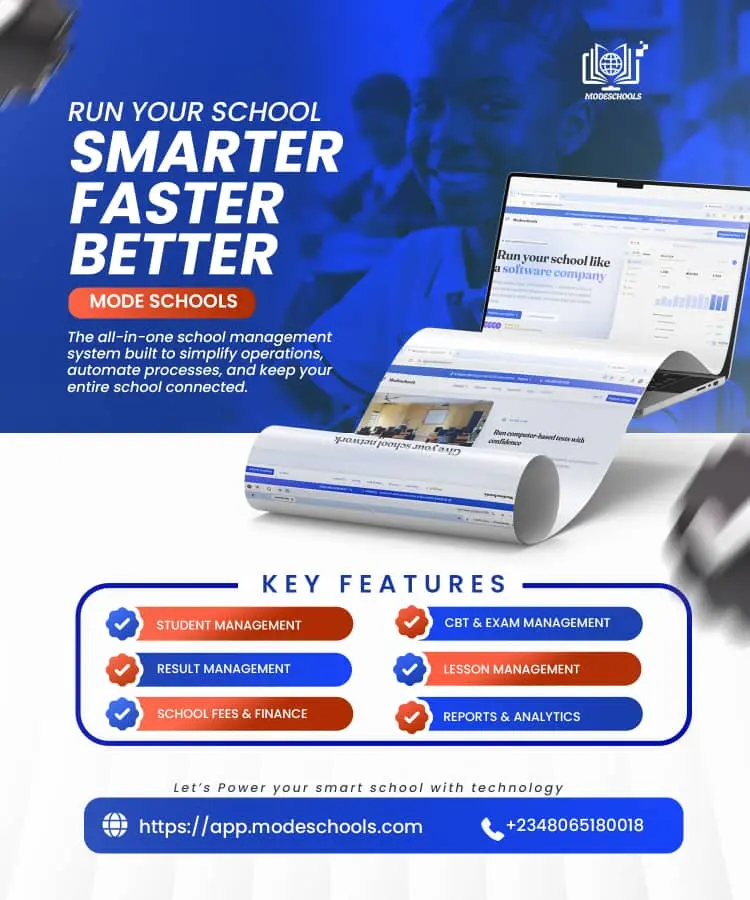
That is why we are thrilled to introduce Modebills—a comprehensive, next-generation school management system designed to streamline every aspect of your institution’s daily operations.

Revolutionizing School Assessments

What sets Modebills apart is its robust, built-in examination engine. Say goodbye to fragmented external platforms. With Modebills, schools can seamlessly create, schedule, and administer internal exams and tests directly within the system, making grading and performance tracking smoother than ever.

Key Features At A Glance

Modebills bridges the gap between administrators, teachers, students, and parents with tailored portals:

  • Comprehensive School Admin Portal: The central nervous system of your school. Effortlessly manage school affairs, track student attendance, and handle fee collections with transparent, automated billing.
  • Logistics & Operations Hub: Seamlessly allocate and monitor hostel accommodations and school bus routes to ensure student safety and logistical efficiency.
  • Teacher Empowerment Tools: Teachers can draft, submit, and manage lesson plans, track course delivery milestones, and manage classroom data all in one place.
  • Real-Time Parent Dashboard: Keep parents actively involved in their child’s academic journey. Parents get instant access to grades, exam results, fee statements, and performance insights.

Why Choose Modebills?

Efficiency Meets Innovation. Modebills isn’t just a tool; it’s an ecosystem that reduces administrative burnout, improves parent satisfaction, and gives educators their time back.

Ready to transform your school’s digital infrastructure?

Let’s build the future of education together.

Contact MODE Digital Creations Limited today on +2348065180018 to schedule a free demo!

#EdTech #SchoolManagement #DigitalTransformation #Modebills #MODEDigitalCreations #EducationInnovation


Discover more from Daily Media NG

Subscribe to get the latest posts sent to your email.

Continue Reading
Advertisement
November 2026
M T W T F S S
 1
2345678
9101112131415
16171819202122
23242526272829
30  

Trending

Discover more from Daily Media NG

Subscribe now to keep reading and get access to the full archive.

Continue reading