The Transforming Power of Education: Digital Education Transformation in the Niger Delta and Beyond
When access meets intelligence, education stops being a privilege and becomes a force.
By Davids Ogan | MD/CEO, Mode Digital Creations Limited
The Question That Changes Everything
There is a question that has been asked in classrooms, in policy chambers, in churches, and around family dinner tables across Nigeria for as long as anyone can remember.
What do you want to be when you grow up?
It is a well-meaning question. It imagines a future. It opens a conversation. But over the years, working with students and families across the Niger Delta, I have come to believe it is the wrong question — or at least an incomplete one.
Because the question assumes that what a child becomes is determined primarily by ambition: by the clarity and strength of their desire for a particular future. It underestimates the degree to which what a child becomes is also determined by what they have access to. What tools they are given. What environments they are placed in. What they are shown is possible for people like them, from places like theirs.
Education, at its most transformative, is not simply the transfer of information. It is the expansion of what a person believes is available to them. It is the shift from I wish to I can. From somewhere else to right here. From someday to now.
Mode Digital Creations was built to make that shift possible for young people in the Niger Delta. And thirty days of building in public, after years of building in the region, has only deepened my conviction that education — specifically, digitally-enabled education delivered with intelligence, accessibility, and genuine community accountability — is the most powerful transformation tool available to this generation.
This is that argument, made in full.
Part One: What Education Actually Does
Before describing what Mode Digital is building, it is worth being precise about what education actually does when it works — because the word is used so broadly in Nigerian public discourse that it has sometimes lost its sharpest meaning.
Education, in its most powerful form, does four things simultaneously.
It transmits knowledge. The foundational work: facts, concepts, frameworks, skills. The content of a Chemistry syllabus. The rules of English grammar. The sequence of historical events. The logic of a mathematical proof. This is necessary. It is not sufficient.
It builds cognitive tools. Beyond content, education builds the mental processes that make content useful: analytical reasoning, structured problem-solving, the ability to evaluate evidence and form judgments, the capacity to learn new things efficiently because you have practiced the act of learning. A student who has genuinely learned Mathematics has not only learned Mathematics — they have developed a tolerance for rigour, a comfort with abstraction, and a habit of checking their work that transfers across every field they enter.
It expands perceived possibility. This is the function that is hardest to measure and most important to understand. When a student from a rural community in Bayelsa sees someone who looks like them, who grew up in conditions like theirs, doing something remarkable — when they encounter knowledge or a tool or an environment that makes them feel, for the first time, that they could do that too — something shifts that no examination can capture. Possibility expands. The ceiling rises. The imagination of what is achievable for a life like theirs is irreversibly enlarged.
It creates accountability structures. Education, when embedded in genuine community — in schools with teachers who care, in families where learning is valued, in societies where knowledge is respected — creates webs of accountability that sustain effort over time. The student who knows their teacher will ask tomorrow what they learned today studies tonight. The student whose family sacrificed for their education carries that sacrifice as motivation. These structures are not glamorous. They are the infrastructure of sustained learning.
Digital education, done well, can amplify all four of these functions simultaneously. Done poorly — as a content dump, a certificate mill, a passive video repository — it amplifies none of them. The difference between powerful digital education and useless digital education is not technology. It is design, delivery, and the genuine understanding of the human beings it is meant to serve.
Mode Digital Creations has spent years learning the difference.
Part Two: The Niger Delta — Education’s Most Instructive Case Study
No region in Nigeria illustrates the relationship between education, access, and transformation more starkly than the Niger Delta.
The region produces the majority of Nigeria’s oil revenue. Its geological fortune has generated trillions of naira in state income over six decades. If the transformative power of resources were sufficient for transformation, the Niger Delta would be among the most developed regions in Africa.
It is not. And the reason it is not is a lesson in what resources alone — without the education, skills, and institutional capability to deploy them — cannot do.
The Niger Delta’s young people have grown up watching the world’s wealth flow past their communities. They have watched oil company executives arrive by helicopter and leave by helicopter, having extracted what their land holds without leaving commensurate human development behind. They have watched peers from better-resourced parts of Nigeria access opportunities that seem structurally unavailable to them — not because of talent, which the region has in extraordinary abundance, but because of access: to quality schools, to digital tools, to the networks and credentials that convert ability into opportunity.
This is the context in which Mode Digital was founded. Not as a comment on the region’s political or economic situation — though that situation is real and urgent — but as a direct response to one specific, solvable dimension of the challenge: the digital skills and education access gap.
The gap is not mysterious. It has clear, addressable components.
Students in the Niger Delta sit the same JAMB examination as students from the most resourced schools in Lagos. They compete on exactly equal terms — with one systematic disadvantage: most of them have had significantly less access to the structured, intelligent, format-accurate preparation that determines performance in a computer-based examination.
Young people in Niger Delta secondary schools have the same capacity for computational thinking as young people anywhere in Nigeria. They have had less access to the coding environments, digital tools, and technical instruction that develops that capacity into functional skill.
Small and medium enterprises in Niger Delta communities serve real customers with real products. They have had less access to the digital infrastructure — websites, online presence, digital marketing capability — that makes businesses visible and competitive in a digital economy.
These are not destiny. They are conditions. And conditions can be changed.
Part Three: The Mode Digital Response — Three Tools for Three Gaps
Mode Digital Creations has built three tools for three specific gaps. Each one is a direct response to a specific, documented need in the Niger Delta and across Nigeria. Together, they constitute a coherent strategy for what digital education transformation actually looks like at the community level.
MODECBT: Transforming Examination Preparation
The first tool addresses the most urgent and immediate gap: JAMB/WAEC examination performance.
In 2024 and 2025, approximately 76–78 percent of Nigerian JAMB candidates scored below 200 — the minimum threshold for most university admission. This is not primarily a knowledge failure. Decades of educational research — and the lived experience of thousands of Nigerian students — confirm that many candidates who underperform on JAMB understand the subject content reasonably well. What they lack is preparation for the specific format of the examination: the CBT interface, the timer, the pressure, and the cognitive demands of making accurate decisions at pace on a screen.
MODECBT was built to close that gap.
The platform carries the full JAMB/WAEC question bank from 1978 to 2025 — every question, every subject, every year. It provides real timed CBT simulation: the same interface, the same timer, the same format as the actual examination. And it provides something no other JAMB platform currently offers at scale: AI-powered explanations for every answer.
Not just “B is correct.” Why B is correct. Why A is a trap. What misconception C is designed to exploit. Which curriculum concept the question is actually testing. How frequently this pattern has appeared in JAMB’s forty-seven-year history.
This explanatory layer — powered by the Gemini API — is the transformative difference between practice and understanding. Between a student who recognises a correct answer when they see it and a student who can derive the correct answer from first principles when the question is framed differently next year.
The transformation MODECBT enables is measurable. Students who use the platform consistently — thirty minutes a day, over six to eight weeks — improve their JAMB scores by margins that translate directly into university access. A student who moves from 171 to 247 has not become more intelligent. They have become better prepared. And better preparation is something every student deserves equal access to, regardless of where they grew up or what resources their family holds.
ModeCodersclub: Transforming the Foundation
The second tool addresses the deeper, longer-term gap: foundational digital skills.
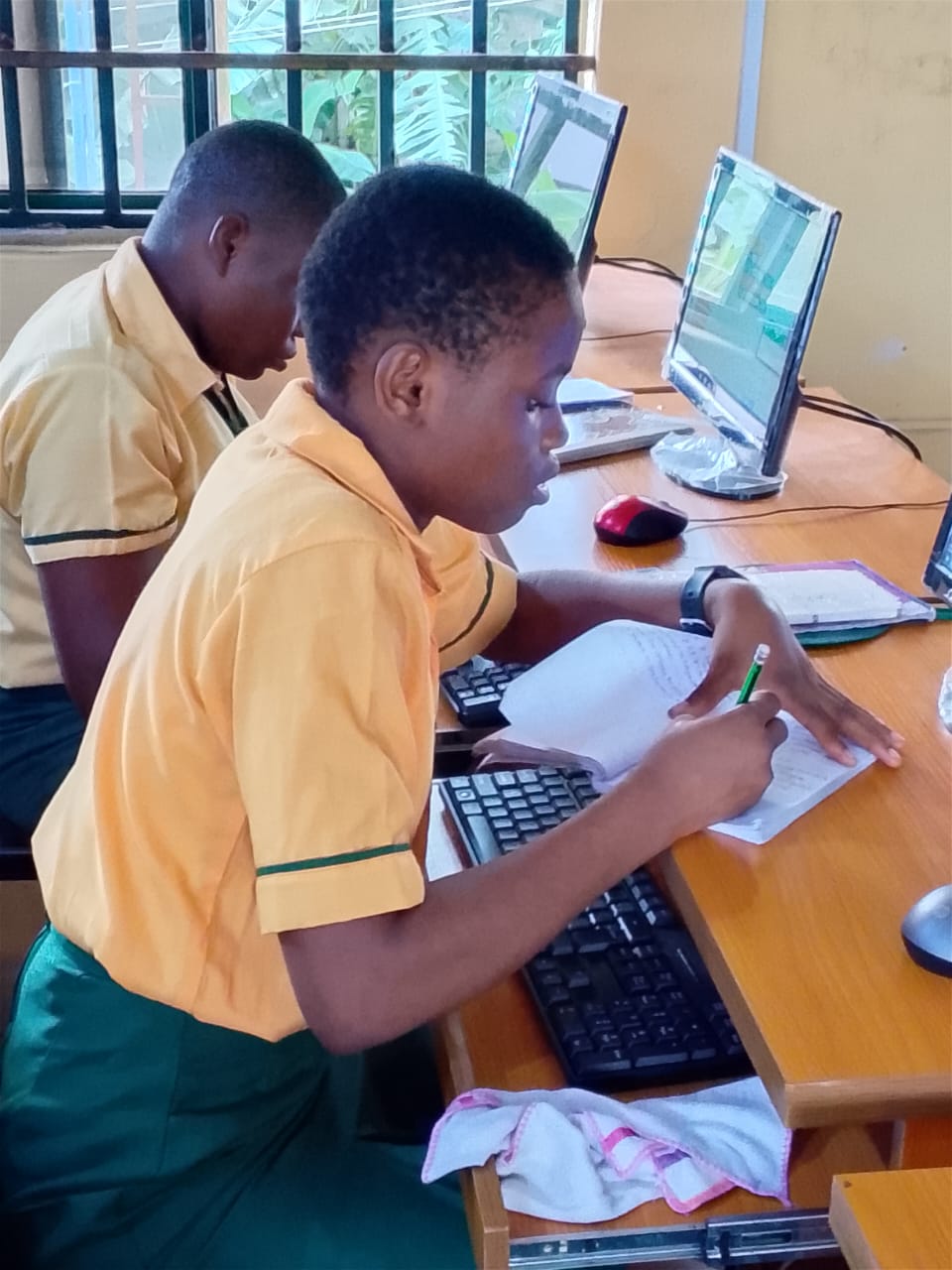
ModeCodersclub is Mode Digital’s digital skills coding programme for primary/secondary school students. Termly. Instructor-led. Delivered in real school classrooms across the Niger Delta. Students learn HTML, CSS, and basic JavaScript, progressing from complete beginners to the builders of working, published websites.
The transformation ModeCodersclub enables operates on two levels.
At the technical level, students gain real, demonstrable digital skills. They leave the programme with a portfolio project — a working URL bearing their name — that they can show at university interviews, scholarship applications, and eventually job interviews. In a competitive graduate labour market, this distinction matters.
At the cognitive level, something more durable happens. Students learn that complex systems are made of understandable parts. That errors are information, not failure. That the act of building something — of making something that did not exist before appear because of decisions and instructions you authored — is available to them. This identity shift, from consumer to creator, is the most consistent outcome we observe in ModeCodersclub students, and it is reported by parents more often than any technical skill.
The Niger Delta’s young people do not lack the capacity for this shift. They have lacked, in many cases, the environment in which the shift was possible. ModeCodersclub creates that environment in their own schools, with instructors who come from and return to their communities, with a curriculum that is built for their infrastructure reality rather than assuming conditions that don’t exist.
This is what education transformation looks like at the grassroots: not a grand programme announced from Lagos, but an instructor in a classroom in Yenagoa asking a fourteen-year-old to build something she has never built before — and watching what happens to her face when it works.
Web Hosting: Transforming Economic Participation
The third tool addresses a gap that is often missed in education-focused conversations: the digital presence gap that makes Nigerian SMEs economically invisible.
Mode Digital’s web hosting service builds professional, mobile-optimised, Google-ready websites for Nigerian small and medium enterprises — at prices calibrated for the Nigerian SME market, with local support from a Nigerian team.
This is education transformation in its applied, economic form.
When a market woman in Warri who has run a successful textile business for twenty years gets a website, something changes. She becomes visible to customers she has never met. She becomes findable by Google search when someone in her city looks for what she sells. She becomes eligible for corporate contracts that require a verified digital presence. Her business — which has always been real, always been excellent — enters an economy from which it was previously structurally excluded.
The transformation is not in the business. The business was already good. The transformation is in the access. In the visibility. In the expansion of what is available to a business that has always deserved more market than word of mouth and WhatsApp could provide.
Part Four: The Philosophy — What Makes Digital Education Transform
Not all digital education transforms. The world is full of EdTech products that have raised investment, generated press releases, and produced minimal improvement in student outcomes. Understanding what makes digital education genuinely transformative — as opposed to merely digital — is important.
From Mode Digital’s experience, genuine educational transformation through digital tools requires five conditions.
Community rootedness. A tool built by people who understand the specific conditions of the community it serves will outperform a generic tool adapted for that community. MODECBT works for Niger Delta students because it was built by people who understand what Niger Delta students face — not as a demographic, but as neighbours. ModeCodersclub works in Niger Delta classrooms because it was designed around the infrastructure and curriculum context of those specific classrooms, not around the infrastructure of a Lagos co-working space.
Accessibility as a design principle, not an afterthought. Transformation cannot be delivered to the people who can already afford it and called inclusive. MODECBT’s free tier, ModeCodersclub’s school-partnership pricing, and web hosting rates built for Nigerian SMEs are not marketing decisions. They are structural commitments to the principle that tools that only reach the already-resourced are not closing gaps — they are reinforcing them.
Intelligence in the feedback loop. The most transformative educational interventions are not those that deliver the most content. They are those that provide the most useful feedback. A student who answers ten questions and receives ten marks learns less than a student who answers ten questions, receives intelligent explanations for every wrong answer, and understands why they went wrong and how to avoid the same error next time. MODECBT’s AI explanation engine is a feedback intelligence investment. It is why the platform produces deeper learning than any volume of unannotated past questions can.
Human accountability structures. Digital tools do not replace human relationships in education. They amplify them. ModeCodersclub’s impact depends on instructors who show up, who engage individual students, who notice when someone is falling behind and adjust. MODECBT’s community presence — the daily social media posts, the personal responses to student DMs, the sense that a real team of people from the Niger Delta is behind the platform — is not incidental to the product’s educational impact. It is part of it. Students who feel seen by the company providing their preparation tool engage more deeply with that tool.
Long-term presence and commitment. Transformation does not happen in a programme cycle. It happens over years of sustained institutional presence — of a company being there when the first cohort of ModeCodersclub students graduates and is still there when they go to university and come back to speak to the next cohort. Mode Digital is building for that duration. The products are investments in a relationship with communities that is measured in decades, not funding rounds.
Part Five: Beyond the Niger Delta — What Nigeria Needs
Mode Digital is a Niger Delta company. It will remain a Niger Delta company. Its primary accountability is to the communities it came from and serves.
But the problems it is solving are not Niger Delta problems. They are Nigerian problems, and in many cases, African problems.
The examination preparation gap — 76–78 percent of JAMB candidates failing to meet university entrance thresholds — is a national crisis. It calls for national-scale solutions. MODECBT, built for the Niger Delta, is scalable to every state in Nigeria. The same AI explanation engine that helps a student in Bayelsa understand why her Chemistry answer was wrong will help a student in Sokoto or Anambra or Cross River understand the same thing.
The digital skills gap — the systematic underrepresentation of Nigerian youth in the digital economy because they were never given foundational digital education — is a national crisis. ModeCodersclub, developed in Niger Delta primary/secondary schools, carries a curriculum and delivery model that is replicable across Nigeria’s 36 states.
The digital business gap — the 70% of Nigerian SMEs that remain invisible to online customers — is a national crisis. Mode Digital’s web hosting and digital presence service, built for Niger Delta businesses, is deployable anywhere in Nigeria.
What the Niger Delta’s experience teaches Nigeria is that the gap between talent and access is not inevitable. It is structural. Structures can be changed. And the organisations most likely to change them are not the ones parachuting in from outside — they are the ones built from within, by people who understand the specific texture of the challenge and have decided to stay and solve it.
Mode Digital is that organisation, for the Niger Delta.
Nigeria needs more of them, for every region the development reports don’t write about.
Part Six: The Invitation
This article is not a conclusion. It is an invitation.
To Nigerian parents: your child’s education does not end at school completion. The gap between what school teaches and what the digital economy rewards is real, documented, and closeable. MODECBT and ModeCodersclub are two tools for closing it. The investment you make in intelligent, format-accurate exam preparation and foundational digital skills today will compound in ways that are genuinely difficult to overstate.
To Nigerian educators: the curriculum is necessary. It is not sufficient. The teachers, school administrators, and lesson professionals who add digital preparation tools to their students’ preparation are not undermining traditional education. They are completing it. We would like to partner with you.
To Nigerian NGOs, foundations, and corporate partners: the students you support through secondary school are arriving at the JAMB gate without the preparation tools that would allow them to pass through it. MODECBT can fill that gap. The conversation is simple and the partnership models are flexible. Reach out.
To Nigerian government and policy institutions — particularly the NDDC: the mandate to develop human capital in the Niger Delta is both constitutional and urgent. A partnership between the NDDC and Mode Digital Creations to sponsor MODECBT access and ModeCodersclub school programmes would put intelligent digital education tools in the hands of thousands of Niger Delta students at a cost that is a fraction of the infrastructure investments the commission routinely makes. The conversation is overdue.
To the students: you are not waiting to be saved. You are waiting to be equipped. MODECBT is at modecbt.com. ModeCodersclub is at your school, or it will be. Come and build something.
Closing: The Wheel Keeps Turning
The title of this article describes Mode Digital as being at the driving wheel of digital education transformation in the Niger Delta.
I want to be honest about what that means — and what it doesn’t mean.
Mode Digital did not start the transformation. The Niger Delta’s communities have been educating their children, demanding better from their institutions, and investing in the future of their young people for generations before Mode Digital existed. The teachers who show up to under-resourced schools every day, the parents who sacrifice to pay school fees on unstable incomes, the students who wake up and study when the power is out and the alternative is despair — they are the transformation. They have always been the transformation.
What Mode Digital brings to the wheel is technology. Intelligence. Product. Scale. The ability to reach a student in Yenagoa at 11pm with an AI explanation for a Chemistry question they got wrong, without a teacher being present, without a textbook being open, without anything more than a phone and a data connection.
That is not everything. But in a region where access has always been the constraint — where the limiting factor has never been desire or talent but infrastructure and tools — it is not nothing.
It is, we believe, the right thing to build.
And we are building it.
For the Niger Delta. For Nigeria. For every student who deserved better preparation than the system gave them and is ready, right now, to make up the difference.
The wheel keeps turning.
Davids Ogan is the founder and MD/CEO of Mode Digital Creations Limited, a digital technology company headquartered in the Niger Delta. Mode Digital built MODECBT (modecbt.com), Nigeria’s AI-powered JAMB CBT preparation platform; offers professional web hosting services for Nigerian businesses; and runs ModeCodersclub, a structured digital skills coding programme for secondary school students.
To explore partnerships, sponsorships, school programmes, or investment in Mode Digital’s work, reach us at: modecbt.com @modecbt X, LinkedIn, Instagram, and TikTok Email: info@modedigitalcreations.ng. Tel. +2348065180018
#DigitalEducation #EdTech #NigerDelta #Nigeria #Transformation #MODECBT #Codersclub #ModeDigital #EducationForAll #DigitalInclusion #NigerianYouth #AfricaTech #JAMBPrep #DigitalSkills #BuildingInPublic