
Politics
Ex-EFCC Chairman Abdulrasheed Bawa Exposes Fuel Subsidy Fraud in Nigeria


Post Links
On June 4, 2025, a significant revelation rocked Nigeria’s anti-corruption discourse as Abdulrasheed Bawa, the former chairman of the Economic and Financial Crimes Commission (EFCC), unveiled his new book, The Shadow of Loot & Losses: Uncovering Nigeria’s Petroleum Subsidy Fraud. In this explosive exposé, Bawa pulls back the curtain on the multi-trillion-naira fuel subsidy fraud that has plagued Nigeria for decades, detailing how billions were siphoned through deceptive practices like ghost imports and over-invoicing. This blog post explores Bawa’s findings, the historical context of Nigeria’s fuel subsidy challenges, and the broader implications for the country’s fight against corruption.
UK Tiktok Creation Blueprint with Monetization tips and Coaching – How to create a U.K. tiktok account

Unveiling the Fuel Subsidy Fraud: Bawa’s Insider Perspective
Abdulrasheed Bawa served as EFCC chairman from 2021 to 2023 under former President Muhammadu Buhari, giving him a front-row seat to Nigeria’s battle against financial crimes. Drawing from his experience as a lead investigator in the 2012 fuel subsidy fraud probe, Bawa’s book offers a detailed account of the mechanisms that enabled widespread corruption in the petroleum sector. Published by CableBooks, an imprint of Cable Media & Publishing Ltd, the book exposes fraudulent strategies that drained Nigeria’s coffers, including:
- Ghost Importing and Over-Invoicing: Companies claimed subsidies for fuel that was never imported or inflated shipment volumes to secure excessive payouts.
- Manipulation of Shipping Documents: Fraudsters altered bills of lading to exploit international price fluctuations, maximizing illicit gains.
- Round-Tripping and Double Claims: Single fuel shipments were used to obtain multiple subsidy payments, a practice that multiplied losses for the government.
- Diversion and Smuggling: Subsidized fuel meant for Nigerian consumers was diverted to black markets or smuggled out of the country for profit.
Bawa emphasizes that these practices thrived due to forged documentation, weak regulatory oversight, and deep-rooted collusion between corrupt government officials and private sector players. He describes the fuel subsidy fraud as a systemic issue, enabled by institutional failures and a lack of accountability in Nigeria’s oil sector.
Historical Context: Nigeria’s Fuel Subsidy Dilemma
The fuel subsidy program, introduced decades ago to keep fuel prices affordable for Nigerians, has long been a double-edged sword. While intended to benefit ordinary citizens, it became a breeding ground for corruption. A 2012 parliamentary report revealed that $6.8 billion was drained from Nigeria’s coffers between 2009 and 2011 due to underhand practices in the subsidy regime, with the Nigerian National Petroleum Company (now NNPC Limited) identified as a key culprit. The report noted a sixfold increase in subsidy spending during that period, highlighting the scale of the problem.
Efforts to reform the system have met with resistance. In 2012, then-President Goodluck Jonathan’s attempt to remove the subsidy sparked nationwide protests, as citizens feared the funds saved would be misappropriated rather than invested in infrastructure. Fast forward to May 2023, when President Bola Tinubu announced the removal of the fuel subsidy, a move that saved over 1 trillion naira ($1.32 billion) in just two months, according to a July 2023 statement by Tinubu. However, this decision also drove up inflation and exacerbated economic hardship for many Nigerians, underscoring the complexity of addressing fuel subsidy fraud.
Systemic Corruption: A Barrier to Development
Bawa’s book goes beyond documenting the fuel subsidy fraud—it serves as a call to action for transparency and reform in Nigeria’s public finance management, particularly in the oil sector. He argues that the billions looted through ghost imports and over-invoicing could have been invested in critical areas like education, healthcare, and infrastructure. Instead, the funds enriched a few corrupt actors while ordinary Nigerians bore the brunt of economic instability.
The revelations also highlight the challenges faced by anti-corruption agencies like the EFCC. During his tenure, Bawa faced criticism for the agency’s inability to tackle high-level corruption effectively, particularly in the oil sector. The systemic nature of fuel subsidy fraud, involving collusion across government and business, makes it difficult to dismantle without comprehensive reforms and political will.

The Road Ahead: Can Nigeria Break Free from Fuel Subsidy Fraud?
Bawa’s exposé comes at a time when Nigeria is still grappling with the fallout of decades-long subsidy mismanagement. While the 2023 subsidy removal was a bold step, its implementation has been marred by challenges, including rising fuel prices and public discontent. Tinubu’s administration has introduced measures like mass transit buses and cheap loans for farmers to cushion the impact, but the underlying issue of corruption in the oil sector remains unresolved.
To address fuel subsidy fraud effectively, Nigeria needs stronger regulatory oversight, stricter enforcement of anti-corruption laws, and greater transparency in the oil industry. Bawa’s book, distributed nationwide by RovingHeights Bookstore, offers a roadmap for policymakers, civil society advocates, and citizens to confront systemic fraud and push for accountability.
Conclusion
Abdulrasheed Bawa’s The Shadow of Loot & Losses is a timely and eye-opening account of Nigeria’s fuel subsidy fraud, shedding light on the billions looted through ghost imports, over-invoicing, and other fraudulent practices. As Nigeria navigates the economic challenges of subsidy removal, Bawa’s call for transparency and reform resonates strongly. The fight against fuel subsidy fraud is far from over, but with concerted efforts, Nigeria can reclaim its resources and build a future where public funds serve the people, not the corrupt.
Discover more from Daily Media NG
Subscribe to get the latest posts sent to your email.



In the ever-shifting landscape of Nigerian politics, the lead-up to the 2027 general elections is already marked by strategic maneuvers and unexpected alliances. A recent revelation by Ladipo Johnson, a prominent figure in the New Nigeria Peoples Party (NNPP), has shed light on the All Progressives Congress (APC)’s overtures to Rabiu Kwankwaso, the NNPP’s 2023 presidential candidate, regarding a potential vice-presidential position. This development, detailed in a video by Channels Television, underscores the complex dynamics at play as parties position themselves for the upcoming electoral battle.
UK Tiktok Creation Blueprint with Monetization tips and Coaching – How to create a U.K. tiktok account
The Revelation
Ladipo Johnson, in an interview with Channels Television, disclosed that members of the APC have been in contact with him, urging Kwankwaso to consider accepting a vice-presidential slot if offered by the ruling party. This revelation is significant, given Kwankwaso’s stature within the NNPP and his influence in Nigerian politics, particularly in the North. The video, which has sparked discussions across political circles, highlights the APC’s strategy to bolster its ticket ahead of the 2027 elections, possibly in response to internal and external pressures.
Context of Political Realignments
This move by the APC comes at a time when the opposition landscape is fragmented, with parties like the Peoples Democratic Party (PDP) and the Labour Party grappling with their own challenges. Recent reports indicate that the APC has been actively seeking to consolidate its position, with President Bola Tinubu receiving endorsements for a second term. The approach to Kwankwaso can be seen as part of a broader strategy to neutralize opposition threats by co-opting influential figures from rival parties.
Implications for the NNPP and Kwankwaso
For the NNPP, Johnson’s disclosure raises questions about the party’s unity and future direction. Kwankwaso, a key figure in the NNPP, has a history of navigating complex political terrains, having previously been associated with both the PDP and the APC before forming the NNPP. His potential alignment with the APC could significantly alter the opposition’s dynamics, potentially weakening the NNPP’s position while strengthening the APC’s northern base.
The Broader Political Scene
The political environment in Nigeria is characterized by fluid alliances and strategic defections, a trend that has been evident since the APC’s formation from a coalition of parties in 2013. The current scenario mirrors past instances where personal ambitions and party strategies intersect, often leading to unexpected partnerships. The NNPP’s openness to compromise, as indicated by Johnson in previous statements, suggests that the party is not immune to these pressures.
Conclusion
As Nigeria approaches the 2027 elections, the political chessboard is being set with moves that could redefine party alignments and electoral outcomes. The APC’s approach to Kwankwaso, as revealed by Johnson, is a testament to the high stakes involved and the lengths to which parties will go to secure victory. For voters and political analysts alike, these developments offer a glimpse into the intricate dance of power that will shape Nigeria’s future.
Discover more from Daily Media NG
Subscribe to get the latest posts sent to your email.

On a tense Monday morning, June 30, 2025, the headquarters of the Peoples Democratic Party (PDP) in Abuja witnessed an unusual sight: armed police officers stationed around Wadata Plaza, effectively blocking access to the party’s National Executive Committee (NEC) meeting and the Board of Trustees (BoT) gathering. This dramatic move has sparked widespread speculation about the state of Nigeria’s leading opposition party, raising questions about internal power struggles, leadership disputes, and the role of security forces in political affairs. As the situation unfolds, understanding the root causes and implications of this takeover is crucial for anyone following Nigerian politics.
UK Tiktok Creation Blueprint with Monetization tips and Coaching – How to create a U.K. tiktok account
The Scene at Wadata Plaza
Eyewitnesses reported a heavy police presence at the PDP secretariat, with officers guarding the gates and restricting entry to key party members, including prominent BoT figures like Maina Chiroma. The planned NEC meeting, a significant event for the party’s decision-making process, was disrupted, leaving staff and journalists baffled. Reports from reputable sources like the Daily Post Nigeria indicate that security personnel even cordoned off Dalaba Street, the road leading to the plaza, heightening the sense of uncertainty. This action suggests a coordinated effort, possibly driven by an “order from above,” as hinted by former PDP National Secretary Umar Tsauri in comments to Channels Television.
The timing couldn’t be more critical. The PDP has been grappling with internal divisions, particularly over the leadership of Acting Chairman Illiya Damagum. The BoT’s recent move to invalidate Damagum’s attempt to cancel the NEC meeting has fueled tensions, setting the stage for today’s confrontation. With the party preparing for future elections, this clash could have far-reaching consequences for its unity and influence.
Unpacking the Leadership Crisis
The PDP’s troubles trace back to a series of internal disputes that have weakened its position since losing the presidential election in 2015. Recent reports from Voice of Nigeria highlight a constitutional crisis within the party, with the NEC’s authority clashing with Damagum’s directives. This power struggle is not new; the party has faced leadership challenges and defections across various regions, as noted in an in-depth analysis by Punch Newspapers. The current standoff appears to be a culmination of these issues, with the BoT asserting its influence against Damagum’s leadership.
Adding another layer to the conflict is the speculated involvement of external political figures. Nyesom Wike, the Minister of the Federal Capital Territory, has been a polarizing figure in Nigerian politics. His recent infrastructure developments, as covered by The Eagle Online, signal his growing clout, leading some to wonder if his influence extends to the PDP’s internal dynamics. While no direct evidence ties Wike to the police action, his past political maneuvers suggest he could be a key player in this unfolding drama.
Why the Police Intervention?
The deployment of armed police to block a political party’s meeting raises serious questions about the role of security forces in Nigeria’s democratic process. According to the Nigeria Police Force’s official website, their mandate includes maintaining public order, but using such measures to halt a party’s internal proceedings is unusual. The lack of clarity on the “order from above” mentioned by Tsauri fuels speculation about political interference, possibly from higher government echelons or rival factions within the PDP itself.
This incident echoes past instances where security forces have been accused of meddling in political affairs, a concern that resonates with Nigerians wary of authoritarian tendencies. The PDP’s response, as it navigates this crisis, will likely shape public perception of its ability to govern effectively if it regains power.
What Lies Ahead for the PDP?
The takeover of the PDP headquarters is more than a temporary disruption; it’s a symptom of deeper issues within the party and Nigeria’s political landscape. As the opposition struggles to present a united front, the outcome of this standoff could determine its relevance in upcoming elections. Party leaders will need to address the leadership vacuum and restore trust among members and supporters.
For now, the situation remains fluid. The PDP must clarify its next steps, whether through legal action, negotiations, or a reshuffling of leadership. Observers will be watching closely to see if this event strengthens or fractures the party further. With the political stakes so high, the coming days will be pivotal.
Conclusion
The armed police takeover of the PDP headquarters in Abuja on June 30, 2025, marks a critical moment for Nigeria’s opposition. Rooted in leadership disputes and possibly influenced by external political forces, this event underscores the challenges facing the PDP as it seeks to reclaim its former dominance.
Discover more from Daily Media NG
Subscribe to get the latest posts sent to your email.
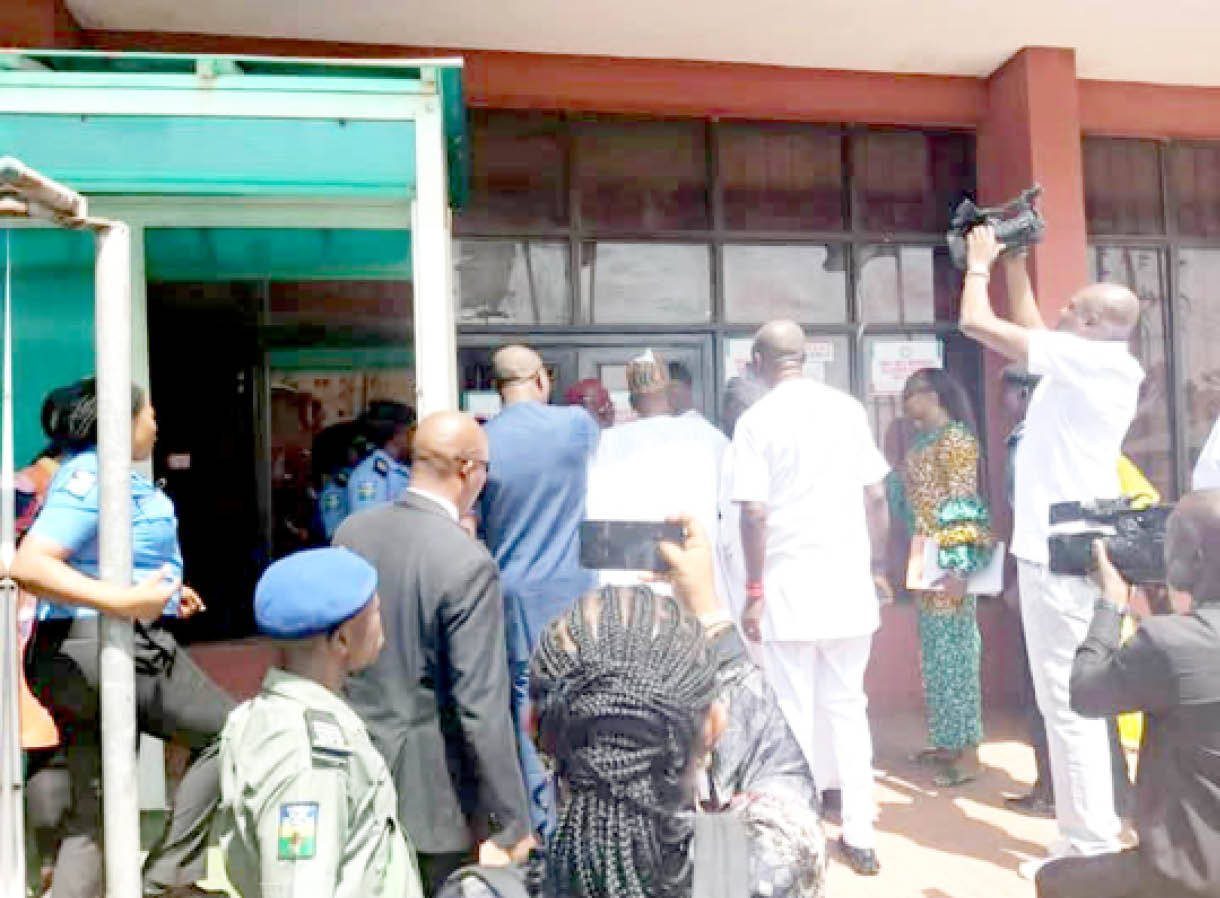
The political landscape in Nigeria is often marked by intense rivalries and power struggles, and recent events at the Peoples Democratic Party (PDP) National Secretariat in Abuja have once again brought these tensions to the forefront. A video captured by Punch Newspapers shows a dramatic scene where police officers are seen manhandling and arresting Thomas Ibu, a staff member from the party’s Publicity Department, amidst an escalating leadership crisis within the PDP. This incident, occurring just before the party’s 100th National Executive Committee (NEC) meeting, underscores the fragility of political stability and the role of security forces in Nigeria’s democratic processes.
The Incident at the PDP Secretariat
On June 30, 2025, the PDP National Secretariat in Wuse Zone 5, Abuja, became the site of a significant disturbance. According to reports from Punch Newspapers, security agents, specifically police officers, surrounded and apprehended Thomas Ibu, a staff member in the Publicity Department. The video footage, which has since circulated widely, shows a tense confrontation where other PDP staff members attempted to intervene but were overpowered by the security operatives. The arrest of Ibu, whose role within the party involves managing public communications, has raised questions about the motives behind such actions and the broader implications for the party’s internal dynamics.
This incident is not isolated but rather a manifestation of deeper rifts within the PDP. The party has been grappling with a leadership crisis, particularly over the position of National Secretary. The controversy surrounding this role has been exacerbated by judicial decisions and internal power struggles, as detailed in recent reports by Tribune Online. The arrest of Ibu occurred against the backdrop of these tensions, with the party preparing for a crucial NEC meeting that could determine its future direction.
Context of the Leadership Crisis
The leadership crisis within the PDP is rooted in a dispute over the legitimacy of decisions made by the Acting National Chairman, which the Board of Trustees (BoT) has labeled as “unconstitutional and unilateral.” This conflict has led to heightened security around the PDP’s national headquarters, with access restricted and visitors subjected to thorough screening, as reported by Naija News. The ongoing saga over the National Secretary position, involving court rulings and refusals to vacate the office, has further complicated the party’s internal stability, threatening its unity and preparedness for future elections.
The arrest of Thomas Ibu can be seen as a direct outcome of these tensions. It reflects a pattern where security interventions are employed to manage or suppress dissent within political parties, a practice that has been documented in previous instances, such as the 2019 arrest of PDP members during a convention. Such actions raise concerns about the erosion of democratic processes and the potential for political disputes to escalate into physical confrontations.
Implications for Nigerian Democracy
The involvement of police in the internal affairs of political parties is a troubling development for Nigerian democracy. It suggests a scenario where law enforcement agencies are drawn into partisan conflicts, potentially undermining their neutrality and the rule of law. The United States Department of State’s recent report on Nigeria highlights systemic issues within the judicial and security sectors, including bureaucratic inertia and undue political influence, which can hamper fair and transparent governance.
This incident at the PDP Secretariat is a reminder of the challenges facing Nigeria’s political institutions. It calls for a reassessment of how security forces are deployed in political contexts and the need for stronger safeguards to protect democratic processes. The role of the media, as evidenced by Punch Newspapers’ coverage, is crucial in holding authorities accountable and ensuring that such events are not overlooked.
UK Tiktok Creation Blueprint with Monetization tips and Coaching – How to create a U.K. tiktok account
Conclusion
The arrest of Thomas Ibu at the PDP National Secretariat is more than just a singular event; it is a symptom of broader political tensions within Nigeria. As the country navigates its democratic path, incidents like these underscore the importance of maintaining the integrity of political institutions and the neutrality of security forces. The PDP’s leadership crisis, compounded by security interventions during the preparations for the NEC meeting, serves as a cautionary tale for other political entities and a call to action for stakeholders to prioritize dialogue and legal processes over force.
In the quest for a stable and democratic Nigeria, addressing these underlying issues is paramount. The events of June 30, 2025, at the PDP Secretariat will likely be remembered as a pivotal moment that highlights the ongoing challenges and the urgent need for reform within the nation’s political landscape.
Discover more from Daily Media NG
Subscribe to get the latest posts sent to your email.


Business4 months ago
Social Media + Website: How Nigerian Small Businesses Use Both Together to Win More Customers

Education4 months ago
Introducing Modebills: The Ultimate All-in-One School Management Ecosystem

Education4 months ago
Igniting Futures: The ModeCodersClub Story

Business4 months ago
How a Website Helped My Niger Delta Business Attract Corporate Clients in Nigeria

Business5 months ago
Why Nigerian Businesses Are Losing Customers Without a Website — And How to Fix It

Education5 months ago
The Transforming Power of Education: Digital Education Transformation in the Niger Delta and Beyond

Career4 weeks ago
From Oil Fields to Mind Fields: How Digital Skills Initiatives Can Power Nigeria’s Next Economy
Business2 months ago
Digital Skills and Entrepreneurship: The Twin Engines Africa Needs

Business3 months ago
Akara Won’t Build Nigeria’s Future

Entertainment7 years ago
GOTV Customer Care Line, Emails, Whatsapp, Phone numbers, Website

Business6 years ago
How to Start Charcoal Export business in Nigeria

Entertainment7 years ago