Connect with us

Education

JAMB Set to Release Rescheduled 2025 UTME Results for 379,000 Candidates: A Deep Dive into the Controversy

Published

on

2025 UTME Results: JAMB to Release Resit Scores for 379,000

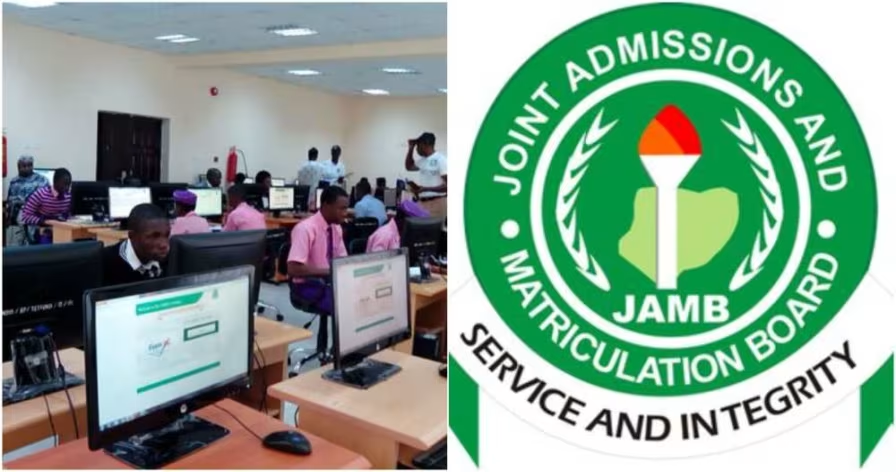
On May 20, 2025, the Joint Admissions and Matriculation Board (JAMB) made headlines with an announcement that the results of the rescheduled 2025 Unified Tertiary Matriculation Examination (UTME) for 379,997 candidates will be released on Wednesday, May 21, 2025. This development follows a tumultuous period for the board, marked by technical failures, allegations of sabotage, and widespread criticism. Let’s explore the details of this situation, its implications for Nigerian students, and the broader challenges facing the country’s educational system.

What Led to the Rescheduling of the 2025 UTME?

The 2025 UTME, a critical examination for Nigerian students seeking admission into tertiary institutions, was marred by significant technical and human errors. According to JAMB’s Registrar, Professor Ishaq Oloyede, these issues affected 379,997 candidates across 157 out of 882 examination centers nationwide. The glitches were particularly severe in Lagos, where 206,610 candidates were impacted, and the South-East, with 173,387 affected students. Oloyede described the situation as a “sabotage,” taking full responsibility for the failure during a press conference at JAMB’s National Headquarters in Bwari, Abuja, on May 14, 2025.

The errors led to distorted scores and an unprecedented rate of mass failure in the initial UTME results, prompting JAMB to reschedule the examination for the affected candidates. The resit exams took place between May 16 and May 19, 2025, with candidates receiving text notifications starting May 15 to inform them of the new schedule. JAMB spokesperson Dr. Fabian Benjamin confirmed that the results of these rescheduled exams would be released on May 21, providing closure for the affected students.

The Fallout: Calls for Resignation and Cancellation

The mishandling of the 2025 UTME has sparked outrage, particularly from the South-East Caucus in the House of Representatives. The caucus, led by Iduma Igariwey (PDP, Ebonyi), labeled the situation a “catastrophic institutional failure” and demanded the immediate resignation of Professor Oloyede. They also called for a complete cancellation of the 2025 UTME, proposing a new examination schedule between July and August 2025, after the completion of the ongoing West African Examinations Council (WAEC) and National Examinations Council (NECO) exams.

The lawmakers criticized JAMB for its poor communication and the short notice given to candidates for the resit exams, which they argued caused “unnecessary trauma” for students. Many of the affected students in the South-East were still taking their WAEC examinations, creating a logistical nightmare. The caucus invoked Section 18(1) of the 1999 Nigerian Constitution, which mandates equal and adequate educational opportunities for all, asserting that JAMB’s failure violated this fundamental right.

Challenges Facing Nigerian Students

The 2025 UTME controversy highlights deeper systemic issues in Nigeria’s educational assessment framework. For many students, the UTME is a gateway to higher education and a brighter future. However, recurring technical glitches, logistical challenges, and administrative failures undermine the integrity of the process. The clash between the rescheduled UTME and ongoing WAEC exams further compounded the stress for students, many of whom were forced to juggle multiple high-stakes examinations with little preparation time.

The South-East Caucus pointed out that the “tainted and flawed” conduct of the 2025 UTME denied thousands of students in the region the opportunity to compete on a level playing field. This raises questions about equity and fairness in Nigeria’s educational system, particularly for students in regions that are disproportionately affected by such failures.

JAMB’s Response and Next Steps

In response to the crisis, JAMB has taken steps to address the immediate concerns of the affected candidates. The board’s decision to reschedule the exams and release the results promptly on May 21, 2025, demonstrates an effort to rectify the situation. However, the broader issues of accountability, transparency, and technological reliability remain unresolved.

Professor Oloyede’s admission of sabotage suggests internal challenges within JAMB that need to be thoroughly investigated. The South-East Caucus has called for a comprehensive probe into the root causes of the failure, arguing that Oloyede’s resignation is necessary to ensure an impartial inquiry. Whether this demand will be met remains uncertain, but it underscores the need for systemic reforms to prevent future occurrences.

What This Means for the Future of UTME in Nigeria

The 2025 UTME saga serves as a wake-up call for JAMB and other educational bodies in Nigeria. To restore public confidence, JAMB must invest in robust technological infrastructure, improve communication with candidates, and ensure that examination schedules do not conflict with other critical academic activities like WAEC and NECO exams. Additionally, the board should prioritize transparency and accountability to address allegations of sabotage and institutional failure.

For students, parents, and educators, this situation highlights the importance of advocating for a more reliable and equitable educational system. The government, on its part, must uphold its constitutional obligation to provide equal educational opportunities for all Nigerian children, as mandated by Section 18(1) of the 1999 Constitution.

Conclusion

As JAMB prepares to release the rescheduled 2025 UTME results on May 21, 2025, the focus remains on the 379,997 candidates who have endured weeks of uncertainty. While the release of these results will bring relief to many, it does not erase the broader challenges exposed by this controversy. The call for Professor Oloyede’s resignation, the demand for a fresh UTME, and the need for systemic reforms all point to a critical juncture for Nigeria’s educational assessment system. Moving forward, stakeholders must work together to ensure that such failures do not recur, so that Nigerian students can pursue their dreams without unnecessary obstacles.


Discover more from Daily Media NG

Subscribe to get the latest posts sent to your email.

Click to comment

Leave a Reply

Your email address will not be published. Required fields are marked *

Business

Digital Skills and Entrepreneurship: The Twin Engines Africa Needs

Published

on

Digital Skills and Entrepreneurship: The Twin Engines Africa Needs

Digital Skills and Entrepreneurship: The Twin Engines Africa Needs

Africa’s population is its greatest asset and, if we get the next decade wrong, its greatest missed opportunity. By 2030, hundreds of millions of young Africans will be entering the workforce. The question that should keep every policymaker, educator, and business leader on the continent awake at night is simple: what will these young people actually be able to do?

I have spent the last several years building a company around a conviction that shapes everything we do at MODE Digital Creations: Africa’s economic future will not be decided by the resources beneath our soil, but by the skills inside our people. Digital skills training and entrepreneurship are not parallel tracks running alongside economic development — they are the tracks economic development runs on.

The Skills Gap Is Not a Future Problem, It’s a Present One

We often talk about the “future of work” as though it’s a distant horizon. It isn’t. The future of work is already here, and it is digital. Yet across much of Africa, our education systems are still preparing children for an economy that no longer exists in its old form. A student can graduate secondary school having never typed a document, built a spreadsheet, or understood how the internet actually works as a tool for commerce and communication.

This is why we made the decision, from the very start, to focus digital skills training on school-age children rather than waiting until university or the job market to intervene. Skills compound. A twelve-year-old who learns to code, to think computationally, and to see technology as something they can build with — not just consume — carries that advantage for the rest of their working life. We are not just teaching children to use computers; we are teaching them to see themselves as creators, not just consumers, of digital tools.

But training children is only half the equation. Schools themselves are institutions under enormous administrative strain, often run on paper records and manual processes that consume time and resources better spent on teaching. This is why we also build School Management System tools — because digital transformation has to happen at the institutional level too, not just in the classroom. An efficiently run school is a school with more capacity to actually educate.

Entrepreneurship Is the Multiplier

Here is where I think the conversation about Africa’s digital future often falls short: skills alone do not transform economies. Skills need an outlet. And for most young Africans, that outlet will not be a job at a large corporation — it will be a business they build themselves.

Africa already has the highest rate of entrepreneurial activity in the world by necessity. What we lack is not the entrepreneurial spirit but the infrastructure to let that spirit succeed at scale. This is precisely why access to affordable web hosting and domain registration matters so much more than it might appear on the surface. A small trader in Enugu or a tailor in Kano with a website and a registered domain is no longer confined to foot traffic in a local market — they are, in principle, competing and trading on the same internet as businesses anywhere in the world.

When we help small and medium enterprises take their businesses online, we are not just providing a technical service. We are handing them a multiplier. A business with a digital presence can reach customers beyond its immediate geography, build trust through a professional online identity, and operate with the kind of visibility that used to require far more capital than most SMEs have access to.

Where the Two Meet

The real transformation happens where digital skills training and entrepreneurship intersect. A generation trained from childhood to think digitally does not need to be convinced to start online businesses later — it is second nature to them. And an SME support ecosystem that makes it easy and affordable to get online ensures that when these digitally fluent young people are ready to build something, the infrastructure is there to support them.

This is not a theoretical pipeline. It is one we see working in practice: children we have trained who go on to build small digital projects of their own; school administrators who, freed from manual paperwork, invest more energy into curriculum; small business owners who, for the first time, have customers finding them online rather than only through word of mouth.

What Needs to Happen Next

None of this, scales on the effort of individual companies alone. If Africa is serious about turning its demographic weight into economic strength, three things need to happen faster than they currently are:

First, digital literacy needs to be treated as a foundational subject, not an elective — embedded in curricula from primary school, not introduced as an afterthought in secondary school or left entirely to private providers like us to fill the gap.

Second, the cost of digital infrastructure — hosting, domains, payment processing, connectivity — needs to keep coming down, and policy should actively support that, because every naira an SME doesn’t have to spend on infrastructure is a naira it can spend on growth.

Third, we need far more patient capital and support directed at the companies doing this unglamorous, foundational work of digital enablement. The flashy consumer apps get the headlines, but the infrastructure layer — training, tools, and access — is what everything else is built on.

Africa does not need to wait for a future economy to arrive. The tools to build it are already available. What is required now is the discipline to put digital skills and entrepreneurial capability into the hands of as many young Africans as possible, as early as possible, and to keep clearing the path so that what they build can actually reach the world.

That is the work we have committed ourselves to at MODE Digital Creations. It is work I believe every serious stakeholder in Africa’s future needs to be part of.

Davids Ogan is the Managing Director of MODE Digital Creations Limited.


Discover more from Daily Media NG

Subscribe to get the latest posts sent to your email.

Continue Reading

Education

Introducing Modebills: The Ultimate All-in-One School Management Ecosystem

Published

on

Digital Skills and Entrepreneurship: The Twin Engines Africa Needs

Introducing Modebills: The Ultimate All-in-One School Management Ecosystem

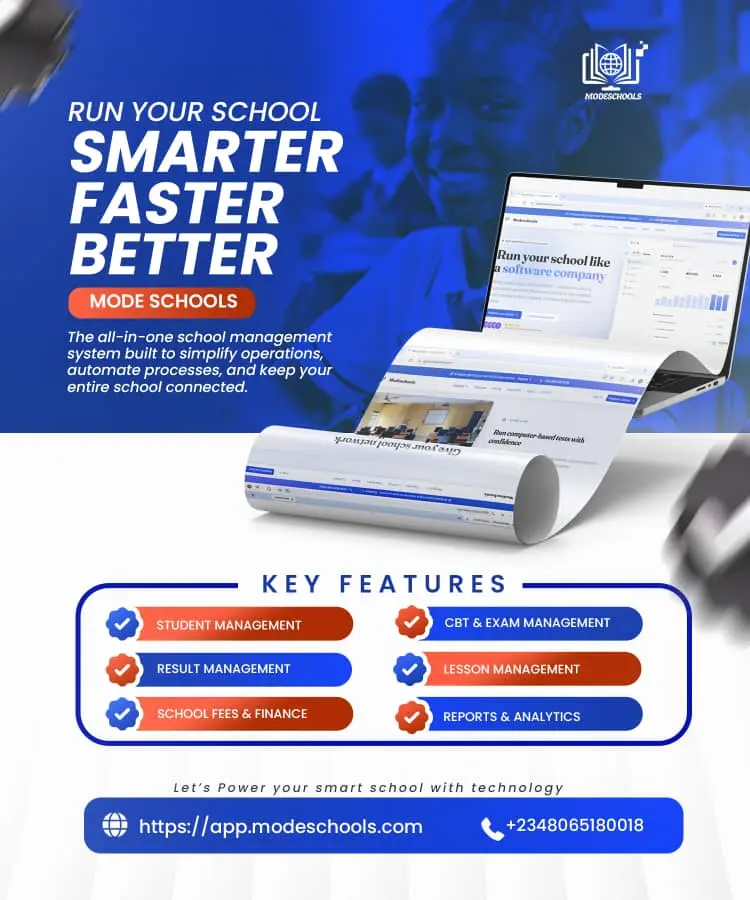
Running a school is a balancing act. Between tracking attendance, managing fees, reviewing lesson plans, and keeping parents in the loop, school administrators and teachers often find themselves buried under mountains of paperwork.

At MODE Digital Creations Limited, we believe technology should do the heavy lifting so you can focus on what matters most: education.

That is why we are thrilled to introduce Modebills—a comprehensive, next-generation school management system designed to streamline every aspect of your institution’s daily operations.

Revolutionizing School Assessments

What sets Modebills apart is its robust, built-in examination engine. Say goodbye to fragmented external platforms. With Modebills, schools can seamlessly create, schedule, and administer internal exams and tests directly within the system, making grading and performance tracking smoother than ever.

Key Features At A Glance

Modebills bridges the gap between administrators, teachers, students, and parents with tailored portals:

  • Comprehensive School Admin Portal: The central nervous system of your school. Effortlessly manage school affairs, track student attendance, and handle fee collections with transparent, automated billing.
  • Logistics & Operations Hub: Seamlessly allocate and monitor hostel accommodations and school bus routes to ensure student safety and logistical efficiency.
  • Teacher Empowerment Tools: Teachers can draft, submit, and manage lesson plans, track course delivery milestones, and manage classroom data all in one place.
  • Real-Time Parent Dashboard: Keep parents actively involved in their child’s academic journey. Parents get instant access to grades, exam results, fee statements, and performance insights.

Why Choose Modebills?

Efficiency Meets Innovation. Modebills isn’t just a tool; it’s an ecosystem that reduces administrative burnout, improves parent satisfaction, and gives educators their time back.

Ready to transform your school’s digital infrastructure?

Let’s build the future of education together.

Contact MODE Digital Creations Limited today on +2348065180018 to schedule a free demo!

#EdTech #SchoolManagement #DigitalTransformation #Modebills #MODEDigitalCreations #EducationInnovation


Discover more from Daily Media NG

Subscribe to get the latest posts sent to your email.

Continue Reading

Education

Igniting Futures: The ModeCodersClub Story

Published

on

Igniting Futures: The ModeCodersClub Story

Igniting Futures: The ModeCodersClub Story

In the heart of Nigeria’s Niger Delta, where rivers wind through resilient communities and dreams often compete with limited opportunities, a bold vision took root. It began not with grand funding or flashy technology, but with a deep, unwavering conviction held by a small team at MODE Digital Creations Limited, led by founder and MD/CEO Davids Ogan.

When they launched ModeCodersClub, they had one singular thing in mind: to democratise digital skills training for school-age children. They believed, with every fibre of their being, that every child from the Niger Delta—and by extension, across Nigeria—deserves a better education and a brighter future. Not just any future, but one where they could code, create, innovate, and compete on their own terms, no matter their background or postcode.

Those early months were filled with determination and quiet hustle. The team crafted a structured, curriculum-aligned programme focused on programming fundamentals, computational thinking, and web development basics—skills designed to spark curiosity and build real problem-solving abilities. They piloted in select private and community schools, adapting lessons for classrooms with shared devices, inconsistent power, and students who had never touched a keyboard before. 

The magic happened in the small moments: a young girl’s face lighting up when her first lines of code made a simple animation dance across the screen; a group of boys high-fiving after debugging their first mini-project together; teachers noticing sharper focus and greater confidence spilling into maths and science classes. What started as after-school or enrichment sessions quickly revealed something powerful—children in the Niger Delta were not just capable of learning to code; they were hungry for it.

Word spread. Classrooms buzzed with energy. Parents began asking how their children could join. Schools that once viewed technology as distant or optional started seeing it as essential. What began as a passionate experiment grew into a movement of joy and excitement. Today, ModeCodersClub runs in over 25 schools and counting across the Niger Delta, touching the lives of hundreds of young learners who now see themselves as future technologists, innovators, and problem-solvers.

The breakthrough moment arrived on 30 April 2026 in Port Harcourt. In a landmark ceremony, MODE Digital Creations Limited signed a Memorandum of Understanding (MOU) with the Rivers State Universal Basic Education Board (RSUBEB). This formal partnership paves the way for ModeCodersClub to be rolled out systematically into government primary and junior secondary schools across Rivers State—beginning with a pilot phase and scaling to reach thousands more children.

Under the agreement, ModeCodersClub provides the ready-to-deploy curriculum, trained facilitators, and flexible digital resources (designed to work even in low-bandwidth or offline settings). RSUBEB ensures access to schools, protected instructional time, and institutional support. It is the first major step in integrating structured coding education into the public basic education system in the state.

Davids Ogan captured the spirit perfectly: 

 “This partnership is not simply about teaching children to write code — it is about equipping the next generation of Niger Delta innovators with the tools they need to build solutions for their communities and compete on the global stage. We started ModeCodersClub because we believed deeply that where a child grows up should not determine whether they can learn to code. Formalising this into the public school system through RSUBEB is the breakthrough we have been working towards.”

Dr Dumani, Director of Teachers Training at RSUBEB, added:  

“Digital skills are no longer optional — they are fundamental. Our collaboration with MODE Digital Creations is a bold step in fulfilling that mandate.”

This MOU also carries the weight of broader endorsement from Rivers State’s education leadership, signalling that digital literacy is now a recognised priority for the state’s children.

Yet even with this hard-won momentum, the work is only beginning. The team’s long-term ambition is ambitious and necessary: to bring ModeCodersClub to 1,000 primary and secondary schools across the Niger Delta within five years. Every new school means more children discovering that they can shape technology instead of merely consuming it. Every new facilitator trained means more sustainable impact. Every device placed in a classroom multiplies opportunity.

This is where you come in.

ModeCodersClub is now actively seeking spirited individuals, organisations, corporate partners, philanthropists, and friends of education to help scale this transformative work. Your support can directly equip the next generation with the digital skills they need to thrive:

– Sponsor devices, learning kits, or offline-capable resources for additional classrooms  

– Fund facilitator training and programme expansion into new local government areas  

– Support scholarships or advanced tracks for standout young coders  

– Partner through CSR initiatives (especially valuable for organisations with roots in the Niger Delta)  

– Volunteer expertise, mentorship, or advocacy

Whether you contribute financially, in-kind, or through connections, you become part of a story that is already rewriting what is possible for children in the region.

The journey of ModeCodersClub is living proof that when vision meets persistence—and when institutions and communities come together—real, lasting change happens. From one powerful idea to over 25 schools, a landmark government MOU, and thousands of young minds awakening to their potential, this is more than a programme. It is a movement of hope, skills, and opportunity.

Every child in the Niger Delta deserves the chance to code their own future.  

Join us in making that future possible. 

Visit https://modecodersclub.com.ng or call +2348065180018 to learn more, explore ways to support, or connect with the team. Together, we can turn today’s spark into tomorrow’s bright, inclusive digital Nigeria.  

The story continues—and the best chapters are still being written by the children themselves.


Discover more from Daily Media NG

Subscribe to get the latest posts sent to your email.

Continue Reading
Advertisement
August 2026
M T W T F S S
 12
3456789
10111213141516
17181920212223
24252627282930
31  

Trending

Discover more from Daily Media NG

Subscribe now to keep reading and get access to the full archive.

Continue reading