Connect with us

Education

Revolutionizing WAEC Biology Prep: AI Tutors Delivering Crystal-Clear Explanations

Published

on

Revolutionizing WAEC Biology Prep: AI Tutors Delivering Crystal-Clear Explanations

In the fast-paced world of education, preparing for the West African Examinations Council (WAEC) exams can be a daunting task, especially for subjects like Biology. With its intricate concepts ranging from cellular processes to ecological systems, WAEC Biology demands not just memorization but a deep understanding.

Enter AI tutors – innovative tools that are transforming how students grasp these complex topics. If you are a student aiming for top grades in WAEC Biology or a parent seeking effective study aids, this guide explores how AI-powered explanations can make learning engaging and efficient. Platforms like www.modecbt.com are at the forefront, offering tailored AI tutoring to help you excel.

Understanding the WAEC Biology Syllabus: A Foundation for Success

Before diving into AI’s role, it’s essential to grasp what WAEC Biology entails. The WAEC Biology syllabus for 2026 is structured into key sections that cover the fundamentals of life sciences. It emphasizes practical knowledge and conceptual clarity, divided into areas such as Variety of Organisms, Form and Functions, Ecology, Heredity and Variations, and Evolution.

Key topics include:

  • Concept of Living: Distinguishing living from non-living things, characteristics of life, and levels of biological organization, from cells to ecosystems.
  • Cell Structure and Functions: Detailed study of cell components like the nucleus, mitochondria, and chloroplasts, including differences between plant and animal cells.
  • Plant and Animal Nutrition: Processes like photosynthesis, respiration, and digestion.
  • Basic Ecological Concepts: Food chains, webs, energy flow, and conservation of natural resources.
  • Variation in Population: Genetics, heredity, mutations, and evolutionary principles.
  • Conservation and Variation: Topics on biodiversity, population dynamics, and human impact on the environment.

This syllabus, which carries a total of 80 marks in the theory paper, requires students to master both theoretical and practical aspects. Many students struggle with visualizing abstract ideas, such as cellular processes or genetic inheritance, which is where AI tutors shine by providing interactive, step-by-step explanations.

The Rise of AI Tutors in Biology Education

Artificial Intelligence (AI) has revolutionized education by personalizing learning experiences. Unlike traditional classrooms where one teacher caters to many students, AI tutors adapt to individual needs, offering 24/7 support. In Biology, AI tools use machine learning to identify knowledge gaps and deliver targeted explanations, making them ideal for Secondary School students preparing for exams like WAEC.

Research shows that integrating AI into Biology self-learning enhances understanding and performance. For instance, AI-powered platforms provide dynamic visualizations and adaptive assessments, addressing challenges in traditional teaching. Students using AI often outperform those relying on conventional methods, with improved retention and engagement.

AI tutors explain concepts through chatbots, virtual simulations, and personalized feedback, turning complex Biology topics into digestible lessons. This approach is particularly beneficial for WAEC candidates, as it aligns with the syllabus’s emphasis on application-based questions.

How AI Tutors Explain Complex Biology Concepts for WAEC

One of the standout features of AI tutors is their ability to break down intricate Biology concepts into simple, step-by-step explanations. Let’s explore how they handle key WAEC topics.

Explaining Cell Structure and Functions

Cell biology is foundational in WAEC, covering organelles and their roles. An AI tutor might start by asking, “What do you know about the mitochondria?” If you are unsure, it provides a tailored response: “The mitochondria, often called the powerhouse of the cell, convert glucose into ATP through cellular respiration. Think of it as the cell’s energy factory.” It then offers hints or quizzes to reinforce learning.

For visual learners, AI can generate or reference diagrams, helping you visualize the differences between prokaryotic and eukaryotic cells – a common WAEC question.

Demystifying Photosynthesis

Photosynthesis, a core topic in plant nutrition, involves light-dependent and light-independent reactions. AI tutors excel here by providing real-time explanations. For example, an AI might say: “Photosynthesis converts carbon dioxide and water into glucose and oxygen using sunlight. It occurs in chloroplasts: First, in the thylakoids, light energy splits water (photolysis), producing ATP and NADPH. Then, in the stroma, the Calvin cycle fixes CO2 into sugars.”

To enhance understanding, AI uses analogies: “Imagine the chloroplast as a solar-powered kitchen where sunlight cooks up food for the plant.” Interactive simulations allow you to adjust variables like light intensity and see outcomes, preparing you for WAEC practicals.

Unraveling Genetics and Heredity

Genetics can be tricky with concepts like Mendel’s laws and DNA replication. AI tutors simplify this: “In monohybrid inheritance, alleles come in pairs – dominant and recessive. For eye color, brown (B) is dominant over blue (b). A Bb genotype shows brown eyes.”

Using Punnett squares, AI generates examples and predicts outcomes, helping with variation and heredity questions. It also explains mutations: “A mutation is a change in DNA sequence, like substituting a base, which can lead to variations in populations.” Visual aids make inheritance patterns clear.


Tackling Ecology and Conservation

Ecology involves food webs and energy pyramids. An AI tutor might explain: “In a food chain, energy flows from producers to consumers. Only 10% transfers to the next level due to heat loss.” It provides scenarios: “If a drought affects producers in a West African ecosystem, how does it impact herbivores?” This builds critical thinking for WAEC essays.

AI adapts explanations based on your progress, offering hints for weak areas like population dynamics or conservation strategies.

www.modecbt.com: Your AI-Powered WAEC Biology Tutor

When it comes to AI tutors specifically for WAEC Biology, www.modecbt.com stands out as a premier platform in Nigeria. This CBT prep tool mimics real WAEC exams while integrating advanced AI features to enhance learning.

ModeCBT’s Intelligent AI Tutor is available 24/7, providing step-by-step breakdowns of Biology answers, hints, and concept teachings. For instance, if you are stuck on a photosynthesis question, the AI explains the process, links it to past WAEC questions, and suggests practice drills.

Other features include:

  • Smart Adaptive Practice: Adjusts question difficulty to focus on weak Biology topics like genetics or ecology.
  • Deep Performance Analytics: Heatmaps and radar charts show mastery in syllabus areas, helping track progress.
  • Predictive Score Forecasting: Uses ML to predict WAEC scores and create personalized study plans.
  • Access to Past Questions: 30+ years of WAEC Biology questions in the Standard Plan (₦5,000 for 3 months).
  • Immersive Simulations: Replicates WAEC’s interface for timed Biology mocks.

Testimonials rave about its impact. Sadiq Ibrahim scored an A1 in WAEC Biology after using adaptive questions to fix weaknesses. Okafor Emmanuel praised AI explanations for clearing confusions in complex topics. With plans from Standard to Premium (₦25,000/year for unlimited access), it’s affordable and effective.

With www.modecbt.com, students gain a tool that not only explains Biology but prepares them for the CBT format of WAEC exams.

Benefits of Using AI Tutors for WAEC Biology Preparation

The advantages of AI tutors extend beyond explanations:

  • Personalized Learning: Adapts to your pace, unlike rigid classroom schedules.
  • 24/7 Availability: Study anytime, ideal for busy WAEC candidates.
  • Improved Retention: Interactive elements like quizzes and visuals boost memory.
  • Cost-Effective: Platforms like www.modecbt.com offer premium features at low costs compared to private tutors.
  • Higher Performance: Studies show AI users excel in Biology, with better scores in heredity and ecology sections.
  • Engagement: Gamified elements, like streaks on ModeCBT, make studying fun.

In a region where access to quality tutors is limited, AI bridges the gap, empowering students from diverse backgrounds.

Tips for Maximizing AI Tutors in Your WAEC Biology Study Routine

To get the most out of AI tutors:

  1. Start with Diagnostics: Use ModeCBT’s analytics to identify weak areas like cell functions or evolution.
  2. Ask Specific Questions: Phrase queries clearly, e.g., “Explain the role of enzymes in digestion for WAEC.”
  3. Combine with Practice: After explanations, tackle past questions to apply knowledge.
  4. Track Progress: Review heatmaps weekly and adjust study plans.
  5. Integrate Visuals: Use AI-generated diagrams for topics like food webs.
  6. Stay Consistent: Set daily goals with AI reminders.
  7. Seek Human Input: Use AI as a supplement, discussing doubts with teachers.

By following these, you will turn AI into a powerful ally for WAEC success.

Conclusion: Embrace AI for WAEC Biology Excellence

AI tutors are game-changers for WAEC Biology, offering detailed, adaptive explanations that demystify the syllabus. From cell structures to ecological principles, these tools provide the clarity needed to ace your exams. Platforms like www.modecbt.com make this accessible with their AI-driven features, past questions, and analytics. Don’t let Biology challenges hold you back – sign up at www.modecbt.com today and transform your prep journey. With AI on your side, an A1 is within reach!


Discover more from Daily Media NG

Subscribe to get the latest posts sent to your email.

Business

Digital Skills and Entrepreneurship: The Twin Engines Africa Needs

Published

on

Digital Skills and Entrepreneurship: The Twin Engines Africa Needs

Digital Skills and Entrepreneurship: The Twin Engines Africa Needs

Africa’s population is its greatest asset and, if we get the next decade wrong, its greatest missed opportunity. By 2030, hundreds of millions of young Africans will be entering the workforce. The question that should keep every policymaker, educator, and business leader on the continent awake at night is simple: what will these young people actually be able to do?

I have spent the last several years building a company around a conviction that shapes everything we do at MODE Digital Creations: Africa’s economic future will not be decided by the resources beneath our soil, but by the skills inside our people. Digital skills training and entrepreneurship are not parallel tracks running alongside economic development — they are the tracks economic development runs on.

The Skills Gap Is Not a Future Problem, It’s a Present One

We often talk about the “future of work” as though it’s a distant horizon. It isn’t. The future of work is already here, and it is digital. Yet across much of Africa, our education systems are still preparing children for an economy that no longer exists in its old form. A student can graduate secondary school having never typed a document, built a spreadsheet, or understood how the internet actually works as a tool for commerce and communication.

This is why we made the decision, from the very start, to focus digital skills training on school-age children rather than waiting until university or the job market to intervene. Skills compound. A twelve-year-old who learns to code, to think computationally, and to see technology as something they can build with — not just consume — carries that advantage for the rest of their working life. We are not just teaching children to use computers; we are teaching them to see themselves as creators, not just consumers, of digital tools.

But training children is only half the equation. Schools themselves are institutions under enormous administrative strain, often run on paper records and manual processes that consume time and resources better spent on teaching. This is why we also build School Management System tools — because digital transformation has to happen at the institutional level too, not just in the classroom. An efficiently run school is a school with more capacity to actually educate.

Entrepreneurship Is the Multiplier

Here is where I think the conversation about Africa’s digital future often falls short: skills alone do not transform economies. Skills need an outlet. And for most young Africans, that outlet will not be a job at a large corporation — it will be a business they build themselves.

Africa already has the highest rate of entrepreneurial activity in the world by necessity. What we lack is not the entrepreneurial spirit but the infrastructure to let that spirit succeed at scale. This is precisely why access to affordable web hosting and domain registration matters so much more than it might appear on the surface. A small trader in Enugu or a tailor in Kano with a website and a registered domain is no longer confined to foot traffic in a local market — they are, in principle, competing and trading on the same internet as businesses anywhere in the world.

When we help small and medium enterprises take their businesses online, we are not just providing a technical service. We are handing them a multiplier. A business with a digital presence can reach customers beyond its immediate geography, build trust through a professional online identity, and operate with the kind of visibility that used to require far more capital than most SMEs have access to.

Where the Two Meet

The real transformation happens where digital skills training and entrepreneurship intersect. A generation trained from childhood to think digitally does not need to be convinced to start online businesses later — it is second nature to them. And an SME support ecosystem that makes it easy and affordable to get online ensures that when these digitally fluent young people are ready to build something, the infrastructure is there to support them.

This is not a theoretical pipeline. It is one we see working in practice: children we have trained who go on to build small digital projects of their own; school administrators who, freed from manual paperwork, invest more energy into curriculum; small business owners who, for the first time, have customers finding them online rather than only through word of mouth.

What Needs to Happen Next

None of this, scales on the effort of individual companies alone. If Africa is serious about turning its demographic weight into economic strength, three things need to happen faster than they currently are:

First, digital literacy needs to be treated as a foundational subject, not an elective — embedded in curricula from primary school, not introduced as an afterthought in secondary school or left entirely to private providers like us to fill the gap.

Second, the cost of digital infrastructure — hosting, domains, payment processing, connectivity — needs to keep coming down, and policy should actively support that, because every naira an SME doesn’t have to spend on infrastructure is a naira it can spend on growth.

Third, we need far more patient capital and support directed at the companies doing this unglamorous, foundational work of digital enablement. The flashy consumer apps get the headlines, but the infrastructure layer — training, tools, and access — is what everything else is built on.

Africa does not need to wait for a future economy to arrive. The tools to build it are already available. What is required now is the discipline to put digital skills and entrepreneurial capability into the hands of as many young Africans as possible, as early as possible, and to keep clearing the path so that what they build can actually reach the world.

That is the work we have committed ourselves to at MODE Digital Creations. It is work I believe every serious stakeholder in Africa’s future needs to be part of.

Davids Ogan is the Managing Director of MODE Digital Creations Limited.


Discover more from Daily Media NG

Subscribe to get the latest posts sent to your email.

Continue Reading

Education

Introducing Modebills: The Ultimate All-in-One School Management Ecosystem

Published

on

Digital Skills and Entrepreneurship: The Twin Engines Africa Needs

Introducing Modebills: The Ultimate All-in-One School Management Ecosystem

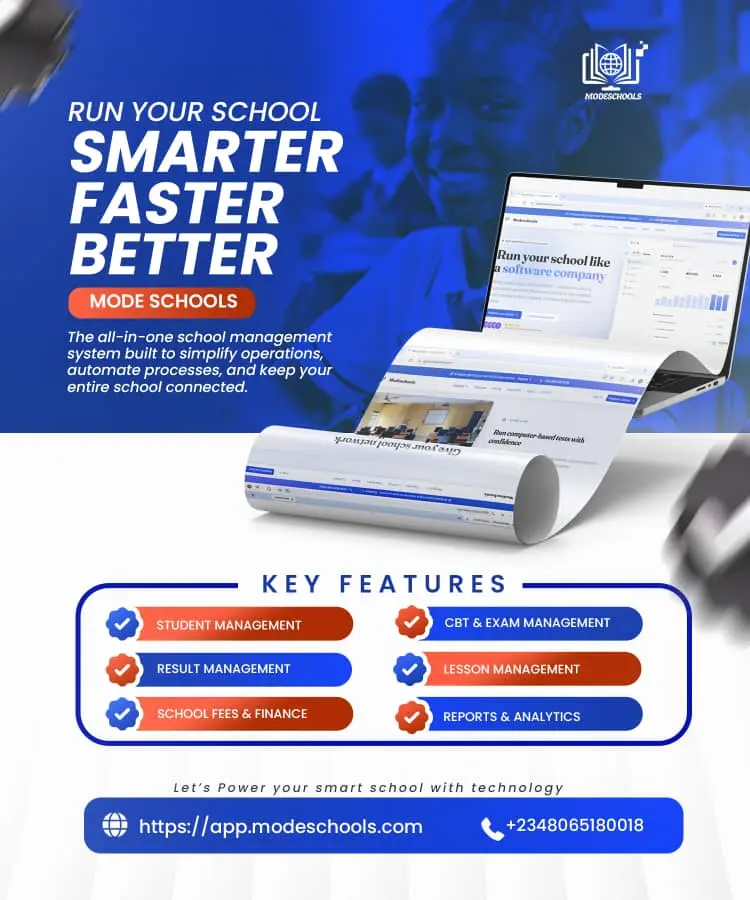
Running a school is a balancing act. Between tracking attendance, managing fees, reviewing lesson plans, and keeping parents in the loop, school administrators and teachers often find themselves buried under mountains of paperwork.

At MODE Digital Creations Limited, we believe technology should do the heavy lifting so you can focus on what matters most: education.

That is why we are thrilled to introduce Modebills—a comprehensive, next-generation school management system designed to streamline every aspect of your institution’s daily operations.

Revolutionizing School Assessments

What sets Modebills apart is its robust, built-in examination engine. Say goodbye to fragmented external platforms. With Modebills, schools can seamlessly create, schedule, and administer internal exams and tests directly within the system, making grading and performance tracking smoother than ever.

Key Features At A Glance

Modebills bridges the gap between administrators, teachers, students, and parents with tailored portals:

  • Comprehensive School Admin Portal: The central nervous system of your school. Effortlessly manage school affairs, track student attendance, and handle fee collections with transparent, automated billing.
  • Logistics & Operations Hub: Seamlessly allocate and monitor hostel accommodations and school bus routes to ensure student safety and logistical efficiency.
  • Teacher Empowerment Tools: Teachers can draft, submit, and manage lesson plans, track course delivery milestones, and manage classroom data all in one place.
  • Real-Time Parent Dashboard: Keep parents actively involved in their child’s academic journey. Parents get instant access to grades, exam results, fee statements, and performance insights.

Why Choose Modebills?

Efficiency Meets Innovation. Modebills isn’t just a tool; it’s an ecosystem that reduces administrative burnout, improves parent satisfaction, and gives educators their time back.

Ready to transform your school’s digital infrastructure?

Let’s build the future of education together.

Contact MODE Digital Creations Limited today on +2348065180018 to schedule a free demo!

#EdTech #SchoolManagement #DigitalTransformation #Modebills #MODEDigitalCreations #EducationInnovation


Discover more from Daily Media NG

Subscribe to get the latest posts sent to your email.

Continue Reading

Education

Igniting Futures: The ModeCodersClub Story

Published

on

Igniting Futures: The ModeCodersClub Story

Igniting Futures: The ModeCodersClub Story

In the heart of Nigeria’s Niger Delta, where rivers wind through resilient communities and dreams often compete with limited opportunities, a bold vision took root. It began not with grand funding or flashy technology, but with a deep, unwavering conviction held by a small team at MODE Digital Creations Limited, led by founder and MD/CEO Davids Ogan.

When they launched ModeCodersClub, they had one singular thing in mind: to democratise digital skills training for school-age children. They believed, with every fibre of their being, that every child from the Niger Delta—and by extension, across Nigeria—deserves a better education and a brighter future. Not just any future, but one where they could code, create, innovate, and compete on their own terms, no matter their background or postcode.

Those early months were filled with determination and quiet hustle. The team crafted a structured, curriculum-aligned programme focused on programming fundamentals, computational thinking, and web development basics—skills designed to spark curiosity and build real problem-solving abilities. They piloted in select private and community schools, adapting lessons for classrooms with shared devices, inconsistent power, and students who had never touched a keyboard before. 

The magic happened in the small moments: a young girl’s face lighting up when her first lines of code made a simple animation dance across the screen; a group of boys high-fiving after debugging their first mini-project together; teachers noticing sharper focus and greater confidence spilling into maths and science classes. What started as after-school or enrichment sessions quickly revealed something powerful—children in the Niger Delta were not just capable of learning to code; they were hungry for it.

Word spread. Classrooms buzzed with energy. Parents began asking how their children could join. Schools that once viewed technology as distant or optional started seeing it as essential. What began as a passionate experiment grew into a movement of joy and excitement. Today, ModeCodersClub runs in over 25 schools and counting across the Niger Delta, touching the lives of hundreds of young learners who now see themselves as future technologists, innovators, and problem-solvers.

The breakthrough moment arrived on 30 April 2026 in Port Harcourt. In a landmark ceremony, MODE Digital Creations Limited signed a Memorandum of Understanding (MOU) with the Rivers State Universal Basic Education Board (RSUBEB). This formal partnership paves the way for ModeCodersClub to be rolled out systematically into government primary and junior secondary schools across Rivers State—beginning with a pilot phase and scaling to reach thousands more children.

Under the agreement, ModeCodersClub provides the ready-to-deploy curriculum, trained facilitators, and flexible digital resources (designed to work even in low-bandwidth or offline settings). RSUBEB ensures access to schools, protected instructional time, and institutional support. It is the first major step in integrating structured coding education into the public basic education system in the state.

Davids Ogan captured the spirit perfectly: 

 “This partnership is not simply about teaching children to write code — it is about equipping the next generation of Niger Delta innovators with the tools they need to build solutions for their communities and compete on the global stage. We started ModeCodersClub because we believed deeply that where a child grows up should not determine whether they can learn to code. Formalising this into the public school system through RSUBEB is the breakthrough we have been working towards.”

Dr Dumani, Director of Teachers Training at RSUBEB, added:  

“Digital skills are no longer optional — they are fundamental. Our collaboration with MODE Digital Creations is a bold step in fulfilling that mandate.”

This MOU also carries the weight of broader endorsement from Rivers State’s education leadership, signalling that digital literacy is now a recognised priority for the state’s children.

Yet even with this hard-won momentum, the work is only beginning. The team’s long-term ambition is ambitious and necessary: to bring ModeCodersClub to 1,000 primary and secondary schools across the Niger Delta within five years. Every new school means more children discovering that they can shape technology instead of merely consuming it. Every new facilitator trained means more sustainable impact. Every device placed in a classroom multiplies opportunity.

This is where you come in.

ModeCodersClub is now actively seeking spirited individuals, organisations, corporate partners, philanthropists, and friends of education to help scale this transformative work. Your support can directly equip the next generation with the digital skills they need to thrive:

– Sponsor devices, learning kits, or offline-capable resources for additional classrooms  

– Fund facilitator training and programme expansion into new local government areas  

– Support scholarships or advanced tracks for standout young coders  

– Partner through CSR initiatives (especially valuable for organisations with roots in the Niger Delta)  

– Volunteer expertise, mentorship, or advocacy

Whether you contribute financially, in-kind, or through connections, you become part of a story that is already rewriting what is possible for children in the region.

The journey of ModeCodersClub is living proof that when vision meets persistence—and when institutions and communities come together—real, lasting change happens. From one powerful idea to over 25 schools, a landmark government MOU, and thousands of young minds awakening to their potential, this is more than a programme. It is a movement of hope, skills, and opportunity.

Every child in the Niger Delta deserves the chance to code their own future.  

Join us in making that future possible. 

Visit https://modecodersclub.com.ng or call +2348065180018 to learn more, explore ways to support, or connect with the team. Together, we can turn today’s spark into tomorrow’s bright, inclusive digital Nigeria.  

The story continues—and the best chapters are still being written by the children themselves.


Discover more from Daily Media NG

Subscribe to get the latest posts sent to your email.

Continue Reading
Advertisement
August 2026
M T W T F S S
 12
3456789
10111213141516
17181920212223
24252627282930
31  

Trending

Discover more from Daily Media NG

Subscribe now to keep reading and get access to the full archive.

Continue reading